


Dallas Willard told his Fuller class what a person wants from a dentist: knowledge, not warm belief. The person over the teeth needs to know what they are doing. The same holds for a mechanic and a car.
He put that ordinary demand next to the Christian teacher. What are we doing when we stand up to speak? For most of the church's history, the answer was assumed. We were bringing knowledge. Then the content of Christian tradition was moved out of knowledge and into mere "faith," and the standing of the Christian teacher collapsed with it.
This is Lecture 32 of Willard's Fuller series, near the close of the course. You can watch the full lecture or read the transcript here: https://conversatio.org/christian-teachers-and-their-knowledge/?collection=2409
He put the thesis on the screen:
"The historical displacement of the content of Christian tradition out of the category of knowledge and into the category of mere 'faith' has destroyed the standing of the Christian teacher in contemporary society. Nothing is more important today than the recovery of the church as the unique purveyor of essential knowledge in response to the four great questions of life."
What is reality? Who is well off? Who is a really good person? How do you get to be? Those are Willard's four. Jesus Christ and the tradition in which He stands give knowledge of the answers.
Displacement Turned Teachers into Cheerleaders
Go back to Calvin or Luther or Wesley or Edwards and say, "Well, you don't have knowledge, you just have faith," and they would answer, "What is wrong with you?" Through much of American history the minister of the gospel was often the best-educated person in the town. Many university presidents were ministers. People might disagree with the pulpit. They still treated it as bringing the most important knowledge to bear on the most important questions.
Then the standing shifted. Max Picard's The Flight From God names the change as a social reality, not a research advance that proved the church wrong. Modern thought and "science," in a loose sense, took the public chair, and Christian teaching moved to the private opinion lane. Secular institutions still claim some of the answers to the four questions. Ask who in those institutions has them, and no one shows up. Writers of the New Atheist movement, for example, do not represent a body of certified knowledge within the universities and research institutes. On Willard's account, secular education has no ability to address the deepest questions of life.
When the church no longer claims knowledge, the pastor's job changes. We stop bringing what people need in order to live. We start trying to get people to do something.
Knowledge Is Not Belief, Commitment, or Profession
We pick up beliefs the way a suit picks up lint. Children pick up the beliefs of the people around them. Faith, in ordinary speech, often means that readiness to act. It is not yet knowledge.
Knowledge, as Willard defines it:
"You know something if you are able to represent it as it is on an appropriate basis of thought and experience."
Accuracy and foundation. Knowledge cannot come out of thin air. Belief can. Most of what we know, we know on authority, and good authority is authority that can be questioned. That is how most of us know the multiplication tables.
A person believes something when prepared to act as if it were so. It does not have to be so. Belief can be ungrounded, irrational, and false, and it is still belief.
Commitment is choosing and implementing a course of action. A person can commit to something without believing it. A speaker can push people into commitments with threats and pressure and leave belief and knowledge behind. Profession is saying that one believes something. The speaker may not believe it. Whole churches can run on profession and never reach knowledge.
"Am I here to provide knowledge to the people I am speaking to as a Christian teacher?" If we do not think we are bringing knowledge, we will not provide it. Then the work collapses into getting people to do things, often things they do not want to do. Giving. Witnessing. Showing up. A successful minister, on that model, is someone who can get lots of people to do lots of things they do not want to do. That is not a good job.
Knowledge confers something belief and commitment do not:
"the right to act, to direct action, to form and supervise policy and to teach."
If we do not have knowledge, we do not have the right to teach. Truth matters here because action follows belief.
"Truth is like the aiming device on a gun. If it is true and you use it well, you'll hit your target."
"If your beliefs are not true, pretty soon, your actions will be running crosswise of reality."
He told a story about a young woman in a church practicing sexual acts the pastor named from Scripture. Her reply was, "Well, that's your interpretation." Thou shalt not commit adultery. That's your interpretation. The line is a safety valve. It disarms any claim that what a person is doing is wrong. Some interpretations are correct and others are not. The slippery premise is that interpretations are never right. They are only interpretations. Without a claim to knowledge, the pastor has nothing left but cheerleading and pressure.
The Great Commission Makes Students of the Nations
Matthew 28 is how Willard recovers the pastor's job after that collapse. The Great Commission is not a charge to go get people to do things. It is a charge to make disciples, students of the nations, under the teaching of Jesus. Knowledge is what we bring. Not everyone responds. That concession covers the hearer who refuses, not the claim that knowledge is what we owe them, and not the claim that education without knowledge is only another form of misleading. Most people, Willard says, will respond to knowledge by acting in appropriate ways once they have it. Education is the perennial hope of the world for that reason.
Pastors, meaning spokespeople for Christ, are the ones who can be teachers of the nations. They alone have the knowledge content, the social position, the power from God, and the position in God to do it. Willard states the stake:
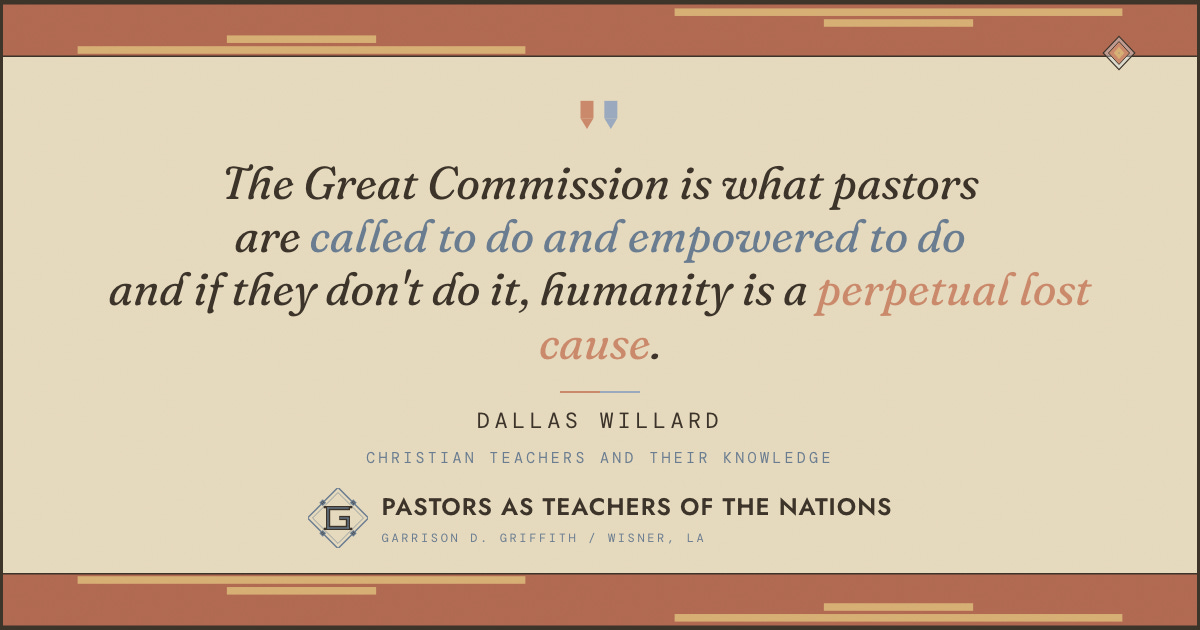
"the Great Commission is what pastors are called to do and empowered to do and if they don't do it, humanity is a perpetual lost cause"
That includes the afterlife. He asks the class whether they sense the dignity of the calling. The weight is the answers human beings cannot manufacture on their own.
Given the New Testament, local congregations might be expected to devote themselves to the spiritual formation of the people who come. They would raise people in 1 Corinthians 13 love, free them from the lust of the flesh and the angers that rise out of it, and make disciples who make disciples under the Presence of God, teaching them how to do everything Jesus said. If this were regarded as knowledge we are teaching, that is likely what would be happening. What we often find instead is constant distraction from that central task. The organization has so many other things to do. Ministers wind up doing work they do not feel the calling was about.
Bring Knowledge and Let Them Decide
One job is getting people to do things they do not want to do. The other is bringing knowledge and then letting them decide. Jonathan Edwards bent over his pulpit reading "Sinners in the Hands of an Angry God." People fell. An elder crawled up and grabbed his leg. They thought they were hearing knowledge. They were being given knowledge of something awful. Edwards did not have to persuade them to fall on the floor. They were ready to go.
If we stand in our world as bringing knowledge, the whole configuration changes. First comes whether we can think of ourselves that way. Whether there is such a thing as the spiritual life, how it is lived, and whether the spiritual disciplines are knowledge we can teach and test, or only a private preference. What am I doing if I am not communicating knowledge?
He gives three moves for the church as an organization, the VIM pattern applied to the body, not only the individual. They do not settle the first question by themselves.
We focus preaching and teaching on entering and living in the Kingdom of the heavens now.
"Talk it! Preach it! Explain it! Live it!"
Begin with what is preached. No big fuss and no battle. Give them a parable of Jesus. Ask what kind of world that is, and who is upside down and who is right side up.
We make sense of discipleship in realistic terms, in work, family, and community. Discipleship practiced in our employments changes the workplace. Business, on Willard's account, is God's arrangement for people to love and serve one another in community. Profit will take care of itself. That is not what business is for. We help people revise their affairs so they can carry through on their decision to follow Jesus where they already spend their days.
We take a few things Jesus taught and help people learn to do them. His line to the class was blunt: stop living for lust and see if you are still breathing. Teach anger the same way. Then teach the positive life Paul names: whatsoever things are true, lovely, pure. A person does not run out of things to do when lust is given up.
This does not require extra budget or facilities.
"It is by far the most successful 'Church Growth' program the earth has ever seen."
It requires clarity, intention, and learning how to do it by experiment. He asked the room, "Can we do that?" He reminded them it has been done. When he gets discouraged he flips back to Count Zinzendorf, or to Calvin in Geneva, and he names the bad with the good. Grant that Geneva burned a man. That grant stops at the failure. It does not cancel that formation under knowledge has already been done, and that we can begin again. "I hope we won't burn anyone."
The three moves are plain enough. Whether we can think of ourselves as bringing knowledge, and stay with that when the organization pulls us into other work, is still the hard part. I do not have a clean fix for that pull. Beginning is still available.
For Reflection
Dallas asked his class, "What am I doing if I am not communicating knowledge?" When you stand to preach or teach this week, what are you doing if you are not communicating knowledge?
Willard distinguishes knowledge, belief, commitment, and profession. Where has your congregation been asked to profess or commit without being enabled to know?
Dallas asked the room, "Can we do that?" Focus preaching on the kingdom now, make sense of discipleship at work and home, and help people learn a few things Jesus taught. Which of those three will you begin without a new budget line?