


Training the body is the part of the Christian life that teaching and preaching must recover. We attend to the soul. We attend to the heart. We attend to the mind. The body goes unattended. Dallas Willard’s eighteenth lecture at Fuller is a sustained refusal of that neglect, and the discipline he uses to refuse it is fasting.
Fasting, Willard says, is “to refrain in some significant degree from food and perhaps all pleasant drink.”
“Fasting is the affirmation and experience of another world.”
As the body refrains from eating the kingdom of God becomes more real than the lunch you skipped.
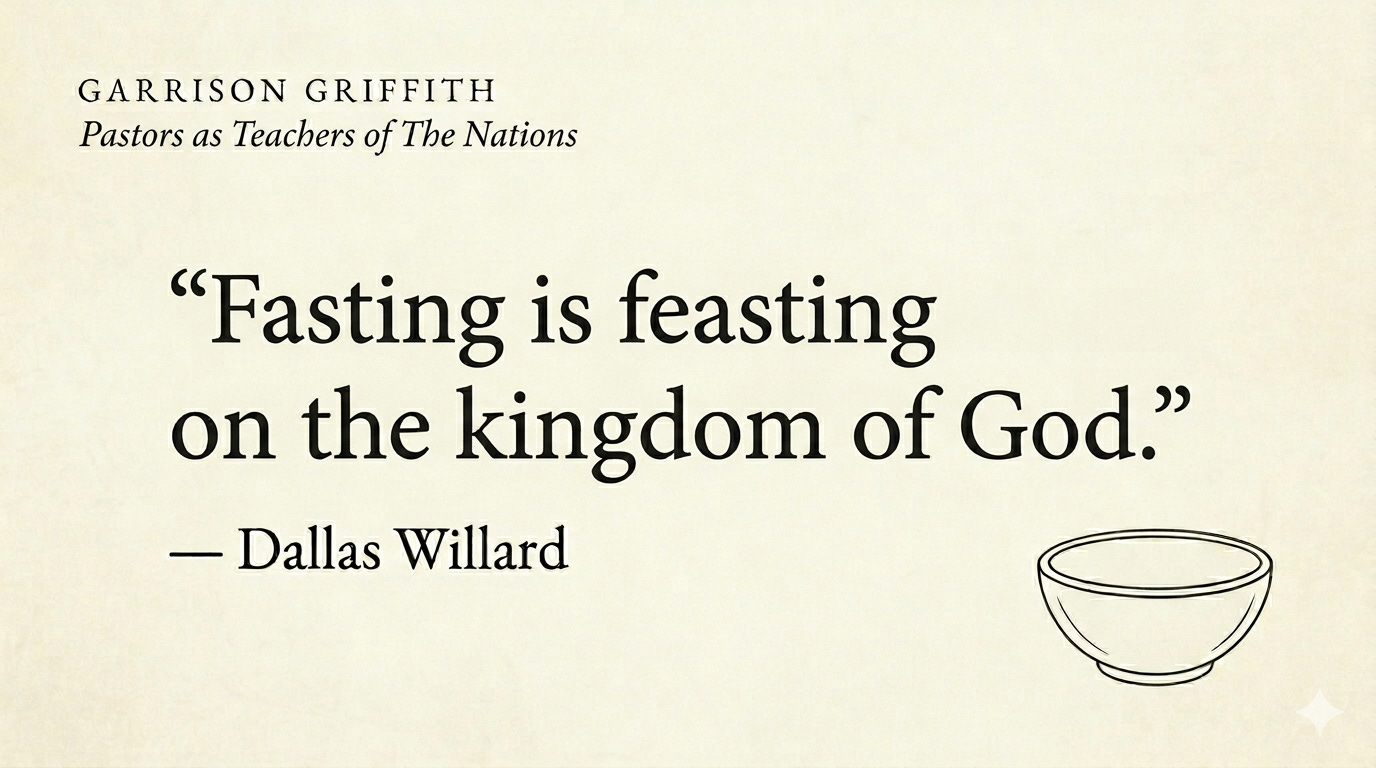
Fasting Is Feasting
“Fasting is feasting” on the kingdom of God. The believer who fasts is not punishing the body. Another source nourishes the believer. The hunger is real, but a deeper hunger gets fed.
In Deuteronomy 8, God led Israel into the wilderness and let them go hungry, “that he might make you know that man does not live by bread alone, but by everything that proceeds out of the mouth of the Lord.”
Israel learned in the wilderness what most of us never learn at the table. The body wants bread. The soul wants the word. The body will tell you it needs bread to survive. The body is partly right and entirely wrong. Bread keeps the body alive. The word of God keeps the person alive.
Fasting teaches the body to tell the truth about what it needs.
Two Kinds of Fasting
The first is disciplinary fasting. Practiced on a regular rhythm. The point is to keep the desires of the flesh from running the show. Disciplinary fasting forms believers who are “strong and cheerful under circumstances of deprivation.”
Strong and cheerful when things are taken away. That is not the natural state of the Christian. That is a state the body has to be trained into, and the training happens through small, regular refusals of food.
The second is functional fasting. Practiced when something urgent demands undivided attention. The biblical examples are Esther fasting before going to the king, and Joel calling the nation to fast in the face of judgment. Functional fasting answers a moment.
Disciplinary fasting prepares believers for functional fasting. A body that has never refused a meal on an ordinary week is not a body that can fast its way through a crisis. The functional fast depends on disciplinary practice the believer has already done.
Ritualistic Fasting as Counterfeit
Disciplinary fasting and functional fasting are faithful expressions of the same discipline. The believer refrains because the kingdom is real and the kingdom is enough. The body learns to live on something other than appetite.
Ritualistic fasting looks identical from the outside, but fails to provide actual transformation.
Isaiah 58 records God’s complaint against a people fasting devoutly while crushing their workers the same afternoon. They wonder why God does not respond. He answers them: “Is not this the fast that I choose: to loose the bonds of wickedness, to undo the straps of the yoke, to let the oppressed go free?” The faithful fast and the rest of the faithful life cannot be pried apart. When they are, fasting becomes a ritual the body performs while the soul stays exactly where it was.
The danger is that ritualistic fasting produces the very thing fasting was meant to dissolve. Pride. Self-righteousness. A sense that the practitioner has accomplished something that God owes them for. The Pharisee in Luke 18 fasts twice a week and goes home unjustified.
A pastor teaching fasting should warn of the danger of making fasting an end in itself. Otherwise our people may start fasting and quietly grow proud of it, and we will have given them a new way to be far from God.
The Body Is Not the Enemy
Last week’s lecture argued that the body is the primary tool for spiritual formation. Direct command cannot reach the soul. Bodily practice can and does.
Fasting is not punishment of the body. It is training of the body. The body is not the enemy of the soul. The body is the soul’s instrument, and instruments need calibration.
Paul calls believers to “present your bodies a living sacrifice, holy and acceptable to God, which is your reasonable service.” The body is the offering. The body is not in the way of the offering, the body is our offering. Fasting is one of the most concrete way we can give our bodies as a living sacrifice.
A body that learns to be hungry without panic teaches the soul that it does not live by bread alone. A body that learns to refuse a craving teaches the soul that it can be ruled by something other than appetite. The body teaches the soul. That is the whole logic of indirection that Willard has been laying out for the last several lectures.
Fasting Confronts Gluttony
Willard defines gluttony as “eating for the sensual pleasure of ingestion.” Gluttony is when ingestion becomes a compulsion rather than a sanctified pleasure.
Most American Christians and Pastors (this one included) are formed by a food culture that is gluttonous.
Fasting confronts that compulsion by removing food long enough for the compulsion to become recognizable. You cannot deal with a hunger you cannot see. The first thing a fast does is show you how much of your hunger was never about food, but about pleasure.
The question underneath fasting is which kingdom rules the body. As long as the cravings of the flesh sit on the throne, the kingdom of God cannot rule there. Fasting unseats the cravings, not by willpower, but by giving the body the experience of being satisfied by something else.
What Pastors Owe Their People
Fasting is a discipline pastors are called to teach, model, and lead a congregation into. A congregation that never fasts is being formed all the same. The grocery aisle is forming them. The drive-through window is forming them. The constant low-grade availability of every pleasure under the sun is forming them. The question is whether their pastor will offer them this practice that interrupts that negative formation.
Willard, paraphrasing Paul to Timothy, calls this leading people into “the life that is truly life.”
A note for pastors:
(The practice of fasting can be hard to introduce into a congregation where it has not been emphasized before. One of the great tools I have used is encouraging the church to embrace a corporate fast on Good Friday. People who have never considered fasting before take it up alongside the whole congregation and begin to see the way their appetites drive them. It has been a meaningful way to introduce the practice, and it adds to the celebration of the crucifixion and resurrection when we break the fast together at our Good Friday Fish Fry. Living in the Catfish Capital of Louisiana and having the largest catfish producers in the area in your church has its perks. Shoutout Haring’s Pride.)
For Reflection
1. Willard asks his students, “What are you addicted to?” He notes that pastors are often addicted to human approval, that praise can function as a kind of food we keep returning to for sustenance. What in your life, beyond the literal table, has become the thing you cannot go a day without? What would refusing it teach you about who is on the throne?
2. Willard tells his students that fasting opens you “to an influence that is not natural.” Do you actually believe that? Or has your prayer time and fasting quietly settled into asking God for things you suspect he is not actually going to do anything about?
3. Willard says his approach to teaching fasting is, “Let’s try it on food for two weeks and see how it goes.” When was the last time you took that kind of experimental posture toward a discipline?
Being formed by the drive-through window is an extremely disturbing thought!
I didn’t stumble across this by mistake. I happen to be on a monthly fast and it had revealed some things l wasn’t aware of about myself . The body needs to be disciplined for sure