


John Wesley watched his converts get rich and panicked.
He had watched them as they had grown in discipline and honest labor. They saved. They stopped spending on drink and vice. And they got wealthy. Wesley, watching it happen across decades of ministry, wrote a sermon called “The Inefficacy of Christianity.” His diagnosis: diligence and frugality produce wealth, and wealth produces pride, love of the world, and every temper destructive of Christianity. His solution: give everything away before it corrupts you.
Dallas Willard thinks Wesley was brilliant and wrong. Wesley could not imagine a Christian teaching that would produce people capable of holding possessions and power without being corrupted. He could not conceive that character could withstand prosperity. So his answer was evacuation. He taught his parishioners get rid of the money before it gets a hold of you.
Willard’s nineteenth lecture at Fuller Seminary argues that the answer is formation, not abject poverty. The question is what your money reveals about what you worship.
You can watch the full lecture or read the transcript here: Frugality and Poverty
Frugality Is Not Poverty
Willard defines frugality as “refraining from indulgence,” where indulgence is “something that goes beyond need and is done just for the sake of the activity in question.” In The Spirit of the Disciplines he puts it this way: “Practicing frugality means we stay within the bounds of what general good judgment would designate as necessary for the kind of life to which God has led us.”
Frugality is attentiveness to what God has called you to, and the freedom to live within those bounds without reaching past them.
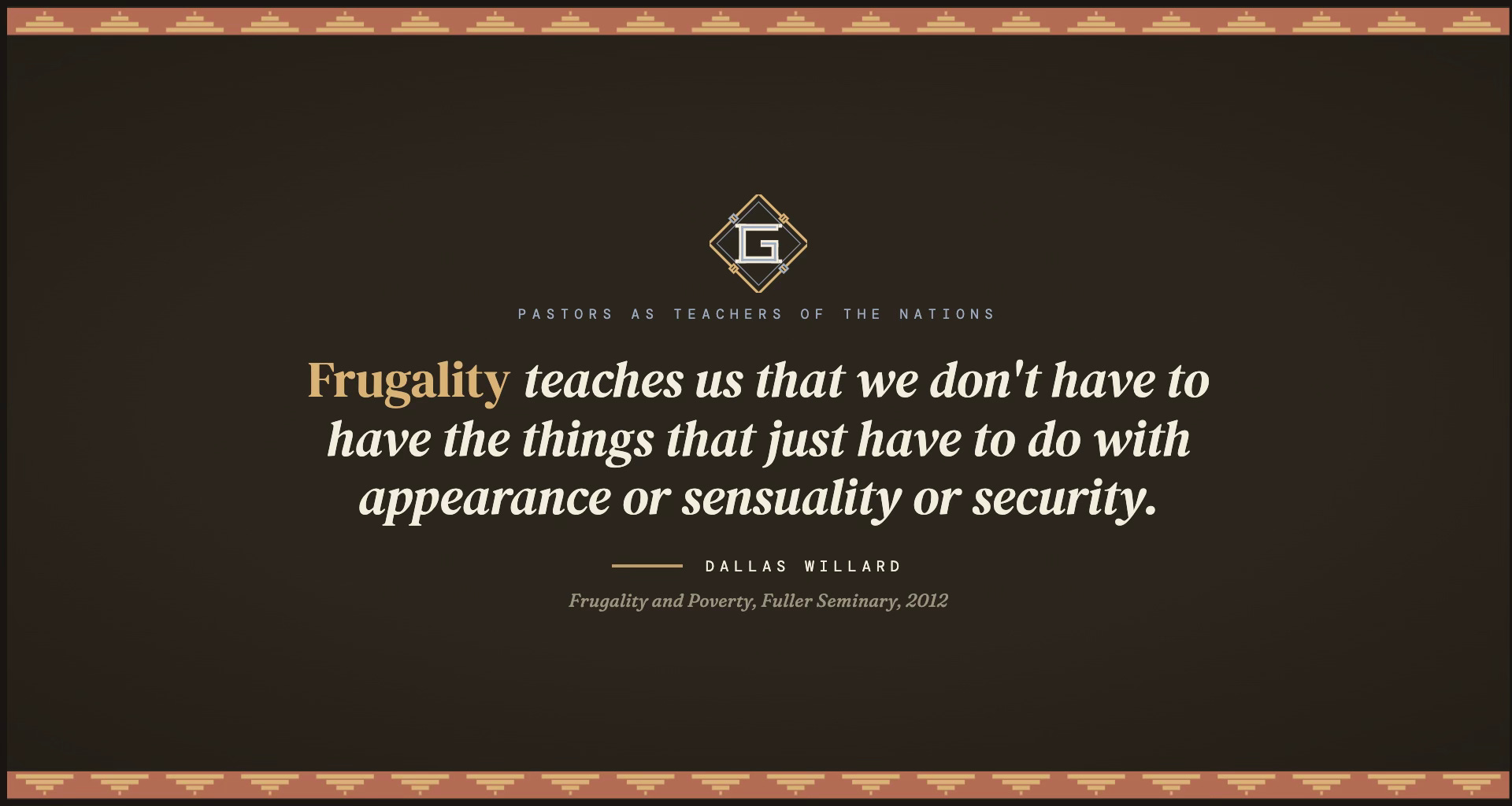
Willard mentions what frugality trains out of us: “the things that just have to do with appearance or sensuality or security.” Legitimate human concerns that become compulsions. The person who cannot pass a sale without buying something has been mastered by love of possessions. The person who cannot give because they might need it someday has been mastered by love of security. Frugality is the slow work of learning which compulsion has hold of you, and refusing to let it master you.
The goal of frugality is desire rightly ordered, desire pointing toward what is good rather than what is pleasurable. The problem it addresses is wanting ordinary things too much: comfort, recognition, the next thing. Frugality is the long, sustained work of learning that the next thing will not complete us. It will not make us grateful. It will not make us free.
The Dangerous Illusion of Poverty
Many spiritual formation conversations treat poverty as the ideal, the vow of poverty, the monk with nothing. Willard calls that “one of the most dangerous illusions for human beings.” Poverty removes the occasion for the discipline; it does not guarantee the formation itself. Jesus did not tell everyone he encountered to sell everything they owned. He told the rich young ruler that, because the rich young ruler’s wealth had become his kingdom. The question is what rules your life? What dominates your desires?
For Willard, stewardship of possessions under the reign of God is “far more of a discipline of the spirit than poverty itself.” The question is what has control of you.
Money Is a Dimension of the Kingdom
Money is a form of power. It shapes neighborhoods. It determines who eats and who does not. It funds the institutions that form children. How disciples use their financial lives is a kingdom matter, not just personal preferences settled between themselves and their accountant.
Willard directs this toward a Christian understanding of vocation. “The main place of discipleship is in our employments.” The workplace, the business, the classroom, the clinic are all places where believers are meant to extend the kingdom as apprentices of Jesus.
When a believer negotiates a contract honestly, sets a wage that reflects the dignity of workers, and resists the industry standard when the industry standard is exploitative, they are not doing something adjacent to their faith. They are living it where Willard says it primarily lives, in their daily work and occupation.
What Charity Cannot Do
Charity “will never make up for” the absence of disciples working within the economic and social order, Willard argues. Charity addresses outcomes. Disciples working within economic systems address causes. The congregation that raises money for the food pantry while none of its members bring kingdom values to the businesses and policies that produce food insecurity have not understood what Willard is after.
That formation does not come just from a sermon series. It comes through the slow work of teaching what the kingdom is, what apprenticeship to Jesus means, and why frugality is a discipline of the soul. Your congregation’s spending power is an indicator of who they serve and what they love. Frugality is the slow, unglamorous discipline of making sure the answer is the kingdom and not the idol.
A note for pastors:
Most churches handle money once or a year during a stewardship sermon or series. People are taught they owe a tithe or that the church can’t make it without them. Yet, nobody teaches them what to do with the rest of what they have.
Addressing that gap is what Willard is after. The business owner in your congregation makes decisions about wages, contracts, and industry standards every week. The finance professional navigates systems that produce poverty or reduce it. Have you formed them for that, or only for securing your churches bottom line?
Formation for the marketplace doesn’t require a new program. It requires a pastor who asks different questions: not “are you giving?” but “how are you bringing the kingdom into your work and wealth?” Those questions, asked over years, produce disciples. Disciples produce different kingdom-centered economies.
For the disciple who wonders whether they have the wrong job or too comfortable a life: encourage them to spend and save as someone whose treasure is in heaven. Teach them in private and from the pulpit to let their financial life be evidence of what they actually believe about where wealth comes from and where it’s going. Frugality is the practice that proves that declaration. Invite them into your spending habits both where you have practiced frugality and where you have failed as an example of how life in the kingdom shapes your spending.
For Reflection
Willard says “the main place of discipleship is in our employments.” When you preach on following Jesus, does the Monday workplace show up as often as the Sunday sanctuary? What would it look like to form your people for the theater where most of their kingdom work happens?
Willard describes frugality as freedom from “things that just have to do with appearance or sensuality or security.” Which of those three categories has the strongest pull on you? How would your financial decisions look different if that category lost its hold?
Willard argues that charity alone “will never make up for” the absence of kingdom workers in the economic order. Who in your congregation is operating in business, policy, or finance? Are you equipping them to work as apprentices of Jesus in those spheres, or are you asking them to fund the ministry and treating that as enough?
Very thought provoking. I need to sit with this a bit. This “new phase” of life we’re in needs some contemplation!