


Dallas Willard believed prayer is the most underestimated power a Christian holds. We treat it as the smallest thing we do, a few words before a meal or a meeting. Willard taught his students to see it as among the largest: real power, exercised alongside God, in the running of the world.
You can watch the full lecture or read the transcript here: https://conversatio.org/prayer-4/
Prayer is power. God shares it on purpose. He backs it with a promise. And in prayer He lets us wield it with Him.
Prayer Is Too Powerful to Treat Lightly
Willard starts with C. S. Lewis. Prayer, Lewis saw, does something in the world. Reading Lewis, Willard calls prayer “fundamentally bringing something to happen,” and names it “a variety of causation.” Prayer belongs in the same sentence as cause and effect. It is one of the ways things come to pass.
Set against that, our usual worry runs backward. We ask whether prayer works, whether it changes anything, whether God was going to act anyway. Willard, following Lewis, moves the worry to the other end. Prayers “have to be handled very carefully,” he says, and the reason runs “not because they are weak but because they are too powerful.” You can be casual with something weak. You give a live wire your full attention.
Think of the person in your church who says, when the bad news comes, that all she can do now is pray. She means it as surrender, the last small thing left when the real options are gone. Willard would turn her gently around. She has reached for the most powerful thing in the room.
God Lends Us the Dignity of Causality
God needs nothing, and still He waits on us. Willard explains the strangeness of that with a line he takes from Pascal, by way of Lewis: “God instituted prayer in order to allow His creatures the dignity of causality.”
God could run the world alone. He arranged things so that some of them wait on our asking anyway, because He wanted us in the work with Him. To be a cause, to move something real by prayer, is a dignity He hands to His creatures on purpose. He went further than permission. He built a world where our asking changes things.
The God we approach in prayer stays close to the controls, and He invites us to His side of them. Willard describes Him as “a person who is a great King over the universe, has great power and He wants to share it with us.” The King opens His hand. That is the wonder at the heart of prayer.
When you teach a teenager or a new believer to pray, you are showing them where God keeps the controls and telling them He wants their hands there too. You are handing them a share of the King’s work. Few things you say from the pulpit will dignify a person more.
Ask in My Name
Willard turns the class to Jesus’ promise about prayer. John 14:13, “Whatever you ask in my name, this I will do, that the Father may be glorified in the Son.” Whatever you ask. It is a hard line to hold at full size, because we have all asked and gotten silence.
Willard slows down on the words we treat as a formula. Most of us hear “in My name” as a phrase we staple to the end of a request to make it land. Willard reads it as the aim of the whole prayer: “to ask in Jesus’ name is to ask for something that is entirely for His benefit.” The promise is real, and it is aimed. It runs toward what God is doing.
That aim is what makes the promise safe to give. A God who said yes to every wish as we first framed it would ruin us. So He ties His yes to His own name and His own purposes, and He invites us to want those with Him.
This gets hardest exactly where we love most. When you pray for your own child, your wants and God’s aims are tangled so tight you can barely tell them apart. Willard leaves the wanting in place and asks God to reshape it, until what you ask for your child is what God is already doing in them.
The child is only the hardest case. Every prayer runs the same way. We bring God what we want, and He answers in line with what He is doing.
He Grows Us Until He Can Say Yes
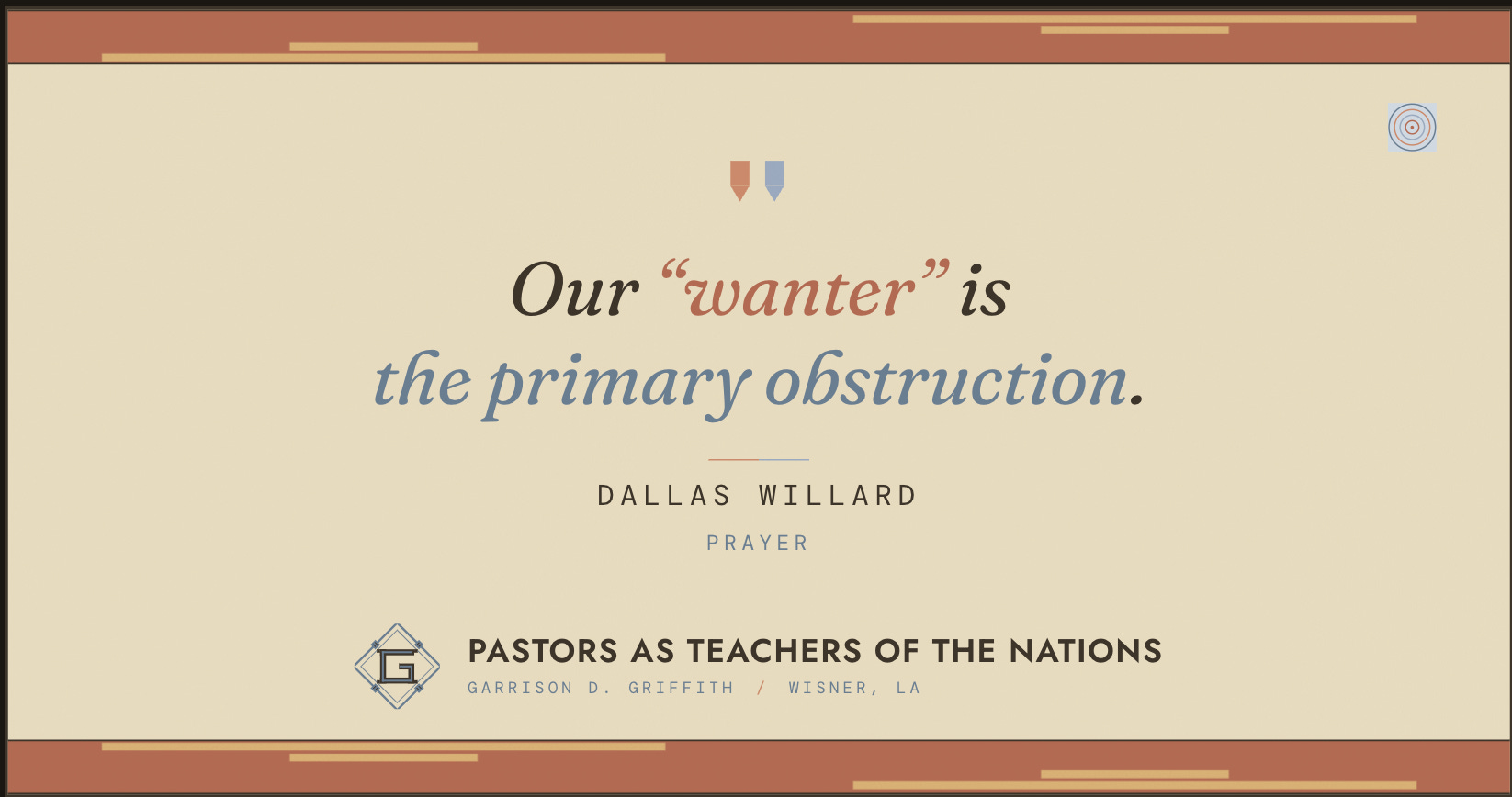
“In this matter of prayer,” Willard says, “our ‘wanter’ is the primary obstruction.” The trouble is less often God’s reluctance than the shape of what we want.
God’s answer to a misshapen wanter is to grow it. His aim, Willard says, is “to bring people to Him and grow them to the point where they could do what they wanted.” God intends to make us so joined to Him that He can hand us the power to do as we please, because by then what we please and what He wills are one thing. The distance between our prayers and their answers is often the room where God is still forming the one doing the asking.
This keeps prayer from collapsing into technique. Push for guaranteed results and, in Willard’s words, “it will turn into magic, and God isn’t into the magic business.” The way in stays low and human. “I pray humbly, dependently,” Willard says, and he makes it concrete: “specificity is the key to prayer.” Name the actual thing. Pray for this person, this town, this need, so that when God moves, you will know it was Him.
Prayer looks less like a long shot and more like an apprenticeship. God hands us the dignity of causality, backs it with His own promise, and takes the years required to grow a wanter He can safely answer. The delay is the care. He is making hands that can hold real power, and that work is already underway in anyone who prays. We start now, specifically and humbly, as people God is bringing all the way in.
For Reflection
Willard says our “wanter” is the primary obstruction. What have you been asking God for that He may be reshaping in you before He answers?
If prayer is God sharing His power with you, where have you treated it as a wish rather than real work you take up with Him?
Willard says specificity is the key to prayer. Name one thing for your church or your town you will pray for this week, and say how you would know God had answered.