


David prays a strange line in the middle of Psalm 51. He tells God, “you teach me wisdom in the secret heart.” The secret heart is the part of a person no one else sees, and David says that hidden place is where God does his deepest teaching. So how do we open it to him?
“It is the discipline of refraining from letting our good deeds be known.”
That is Willard’s definition of secrecy, the twenty-second lecture in his Spirituality and Ministry series. The lecture closes his unit on the disciplines of abstinence. It treats two of them, secrecy and sacrifice, and both go after the same thing in us: the appetites that have quietly taken the throne. Secrecy goes after the hunger to be seen. Sacrifice goes after the need to be secure.
You can watch the full lecture or read the transcript here: Secrecy
Secrecy Kills the Motive, Not the Visibility
Secrecy is not hiding. It is not a vow to never let anyone see you do anything good. The point of the discipline is the motive, not the deed.
Willard takes us to Matthew 6, where Jesus warns against practicing your righteous deeds before men to be noticed. Read carelessly, that passage produces people who think they should never pray in public. Willard says they have misread it. “Jesus is not speaking against being known, He is speaking about acting in order to be known.” The problem was never that the Pharisees gave money or prayed or fasted. The problem was why. They did it to be seen.
So Jesus says the strangest thing about them. They got exactly what they wanted. “They prayed to be seen and what do you know? They got seen. They got their reward.”
The recognition they were chasing was the whole reward. There was nothing else coming. The Father who sees in secret had nothing to add, because the reward they wanted was the only one they would get, and they already had it.
The Father who sees in secret rewards the deed done for Him. The discipline of secrecy trains us to do the good thing and then let it go unannounced, so that the only audience we are performing for is God.
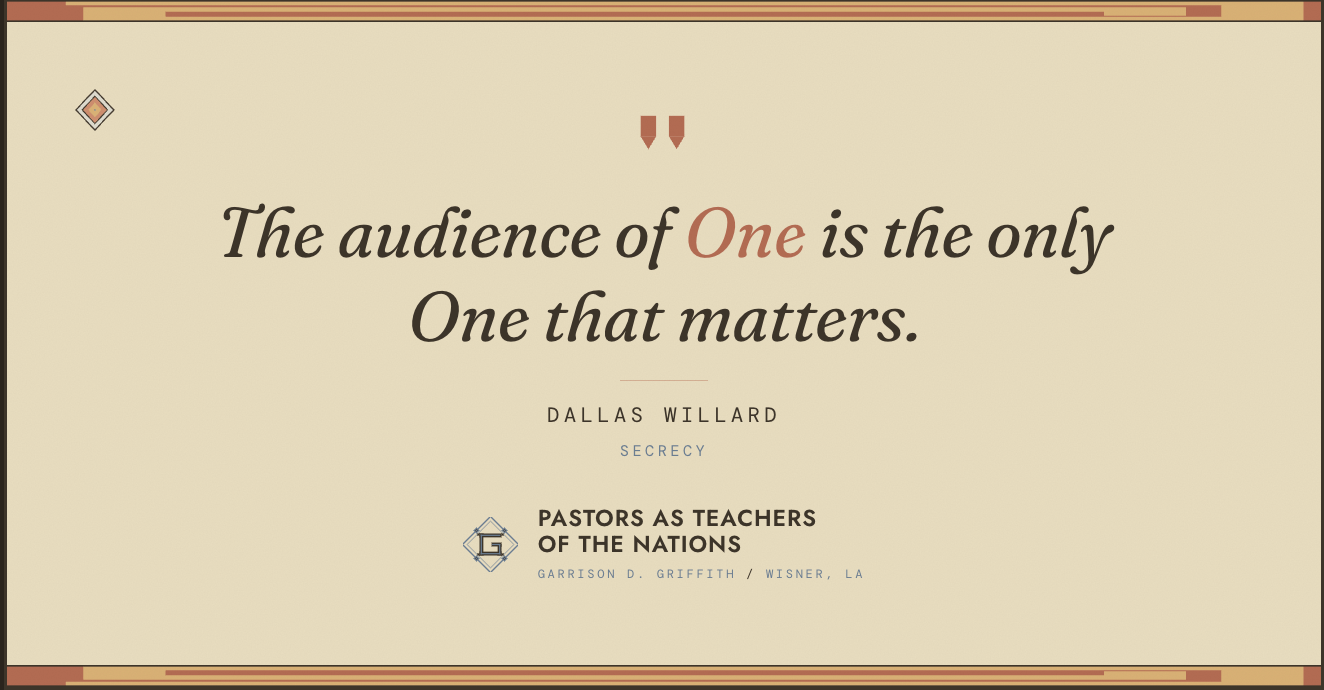
Practicing secrecy “enables us to live and stand before the audience of One. The audience of One is the only One that matters. The others do not matter.”
Here is what that means for the person in your pew, and for you. Most of us feel as if we live in front of a crowd that is always grading us. We do the right thing and then we wait to see if anyone noticed. That waiting is what secrecy goes after. It trains us to do the good and walk away without checking whether anyone clapped.
It Is a Real Load Off Your Back
Willard does not sell secrecy as a heavier yoke. He sells it as relief.
“This practice teaches us to be content without human approval,” he says, “and that our business with God is not filtered through others of necessity. We don’t depend upon the approval of people and that is a real load off your back.”
That load is heavier than we admit. Consider how much of an ordinary day runs on it. The small adjustment you make so a comment lands well. The thing you mention so someone knows you did it. The sting when the work goes unthanked. Willard asks the question straight: how much of your peace and joy depends on people knowing and understanding what you have done?
He reaches back to something he read in Thomas a Kempis years ago. The wording Willard recalls is this: what people say about you “doesn’t make you any different. What you are, you are.” If they speak ill of you, it does not make you ill. If they speak well of you, it does not make you well. The verdict of the crowd has no power to make you into anything. Only God’s seeing does that.
“It is what I call a ‘hygienic’ discipline,” Willard says, “a clean up the mess discipline.” The mess is the residue of a life lived for an audience. It builds up without our noticing, like grime on a window. Secrecy is the cloth that wipes it off. And he says the cleanup would change a great deal: “you can imagine how much of our lives, especially in religion, would be changed if we were not angling for approval or to avoid disapproval.”
Angling for approval or to avoid disapproval. It cuts both ways. Some of us perform to be praised. Others bend everything we do to keep from being criticized. Both are the same bondage. Both hand the throne to the crowd.
The Will Has to Be Trained to Pause
Secrecy belongs to a larger family. Earlier in the same session, Willard and his teaching assistant, Keith Matthews, set up the whole unit on abstinence by talking about desire. Keith quotes a line he attributes to Willard from years back: “Desire is a good servant but a bad master.” The two of them are clear that the Christian aim is not to kill desire, the way a Buddhist might. The aim is to put desire back under the will, where it belongs.
“Desire is an impulse towards an object,” he says, and the trouble is that “it never questions itself.” Desire only ever says one thing: I want that. The will is what asks the second question. The will says, What about that? The will deliberates. And to deliberate, Willard notes, means to free up. The will frees you from being run by the next impulse.
“All of the disciplines are ‘Will training’ and they are trying to liberate you from Desire and the immediacy of Desire,” he says. The disciplines of abstinence, fasting, solitude, silence, secrecy, “always are designed to put Desire on hold and give you a chance to reflect.” They build margin. In that margin the will has room to ask why before the body acts.
Secrecy trains the will in one specific desire: the want to be seen. Every time you do a good thing and choose not to announce it, you have put that desire on hold long enough for the will to choose God instead of the crowd. Do that enough and the desire stops being your master.
Sacrifice Teaches You That God Is Enough
The last discipline of abstinence in Willard’s list is sacrifice, and he treats it differently from the others. “For the most part, this is a discipline which is received.” You do not usually choose it. It comes upon you. Loss arrives, and when it does, you receive it as a discipline rather than as proof that God has left.
Sacrifice is not frugality. “Frugality is not surrendering what is necessary; it is surrendering what is optional and you don’t have to have it but you might indulge.” Frugality lets go of the extra. Sacrifice lets go of the necessary. It releases the thing you depend on for security, the paycheck, the provision, sometimes the person, and trusts that God will hold you anyway.
What it teaches is the lesson underneath all the others. Sacrifice, Willard says, “helps us learn to rest upon the sufficiency of God when we don’t have what we need.” He anchors this in Psalm 138, verses 7 and 8: though I walk in the midst of trouble, You will revive me. He points to Luke 10, where Jesus sends out his disciples with no provision so that they would learn by experience the truth of what they were preaching, that the kingdom of God is at hand. He lands on Paul’s word, that he has learned “to be content with whatever I have, wherever I am.”
And then Willard states the whole point of the discipline in three words he says twice. “What sacrifice and loss helps us know is that God is enough. God is enough!”
That is the pastoral comfort hidden inside the hardest seasons. Profound loss is not the sign that God has abandoned your people. It is the soil where a faith that does not depend on circumstances finally grows. The widow learns it. The man who lost the job learns it. They come out the far side knowing something the comfortable never had to learn: that when the provision is gone, God is still there, and He is enough.
A note for pastors:
The thesis I keep returning to is that the pastor is a teacher of the nations, called to proclaim, teach, and manifest the kingdom. Secrecy is a discipline you cannot proclaim or teach unless you manifest it. You cannot lead anyone out of the hunger for recognition while you are still feeding your own.
Be honest about the trap, because ministry is built out of the exact material secrecy is meant to mortify. Our work is visible by design. We stand up front. We are measured by results we can count and applause we can hear. The whole vocation tilts toward what Willard named: angling for approval, or angling to avoid disapproval. The pastor who needs the sermon to land well so people will think well of him is being run by the crowd, not the kingdom. So is the pastor who avoids the hard text because he cannot bear the cold faces.
The culture of ministry rewards the hunger. Platform, brand, the count of who showed up, the comparison to the church down the road. A man can give his whole life to that audience and, like the Pharisees, get exactly what he chased and nothing more. He prayed to be seen, and he was seen, and that was the reward.
Secrecy is how you climb down off that stage. Do some good your congregation will never hear about. Make some of your requests known only to God. Stop narrating your faithfulness. Let a kindness go unmentioned even when mentioning it would help your reputation. The point is not to become invisible. The point is to be a man whose peace does not rise and fall with the verdict of the room, because he has learned to stand before the audience of One.
That is what manifesting the kingdom looks like here. When your people watch a pastor who is plainly not angling, plainly not wounded by every criticism, plainly not fishing for thanks, they are seeing the freedom the gospel offers made flesh in someone they know. You are not only telling them the load can come off. You are showing them a man who set it down.
For Reflection
Willard says practicing secrecy would change much of our lives, “especially in religion,” if we stopped angling for approval or to avoid disapproval. Where in your ministry this week were you angling for one or the other? What would that same act have looked like if the audience of One were the only audience you cared about?
Willard asks how much of our peace and joy depends on people knowing and understanding what we have done. Answer it honestly about yourself. When your good work goes unnoticed by your people, does your peace survive it, and what does the answer reveal about whose verdict is still on the throne?
Willard says sacrifice teaches us that God is enough, and that this lesson is usually received rather than chosen. Think of someone in your congregation walking through real loss right now. Are you helping them read that loss as evidence God has left, or are you teaching them it is the very place they will learn that God is enough?