


Dallas Willard told a room of students at Fuller in June of 2012 about the young people who came to him, or to their parents, in distress, to “come out”. He told the room how he turns the conversation when it happens.
“Now, how much is there to you other than your homosexuality? Is that all? Are you going to make a life of being homosexual?”
That is the second of Willard’s two lectures on sexuality, and it moves the conversation off the ground the culture wants to fight on. The first lecture taught chastity as the training of desire. This one does something harder. It teaches pastors how to think clearly about sexual sin without crushing the person sitting across from them, and it does so by going underneath the behavior to two questions almost no one in the room has been taught to ask. What is sin, as distinct from temptation? And who is this person underneath their sexuality?
You can watch the full lecture or read the transcript here: Sexuality and Spiritual Life II
Temptation Is Not Sin. The Relenting of the Will Is.
Willard opens this part of the lecture with a pastoral problem he has watched destroy serious Christians, especially the young. They do not know the difference between a thought, a temptation, and a sin. So they treat all three as the same, and they live under a condemnation that is not even true.
He names the source of the confusion. Many of our people read Jesus’ words in Matthew 5 as if a thought is a sin. Willard traces this in part to a translation problem and to what he calls “one of the great ‘sillies’ of the recent, not too recent, past,” Jimmy Carter telling Playboy magazine that he had evil thoughts. Carter, Willard says, was “doing just exactly what is so destructive here,” collapsing the distance between having a thought and consenting to it.
Then Willard draws the line precisely. He distinguishes three things.
First, the thought itself. “The thought of something wrong with no inclination to do it is something you cannot control directly.” A thought can arrive unbidden. You did not invite it, you do not want it, and you cannot keep it from showing up at the door. Willard adds that as the mind is transformed over time, fewer of these thoughts will come. But the bare arrival of a thought is not sin, and it is not even temptation.
Second, temptation. “Temptation is where you have the thought and the inclination and that is where you are apt to tease that out and foster temptation.” Now there is a pull. The thought has company. You feel the lean toward it. Willard is clear that this is “a problem,” a place to be careful, but he is equally clear: “I don’t think He is saying that temptation is sin.”
Third, sin. “Sin is the relenting of the will.” Here the will says yes. Not necessarily the body, not necessarily the act carried out, because circumstances may prevent the deed. Willard’s test is blunt: “would you if you could?” When the answer is yes, the will has relented, and that is the adultery of the heart Jesus names.
Scripture draws the same line. Hebrews says Christ was tempted in every way we are, yet without sin, which means temptation reached him and never crossed into sin. James traces the sequence a step further: desire conceives, and then it gives birth to sin. The thought and the pull are the conception. The relenting of the will is the birth.
Most of our people have lived their whole Christian lives unable to tell the difference between an intrusive thought and a cultivated desire, between being tempted and having sinned. They confess things that are not sins and miss the place where the will relents. When you teach this distinction, you hand a struggling believer something they have been desperate for: an honest map of their own interior, and a place to fight that is not everywhere at once.
The Way Out of Temptation Is the Trained Mind
Willard does not leave the distinction sitting as theory. He turns it into a practice, and it is the same practice the first lecture pointed to.
If sin is the relenting of the will, and temptation is the place where the will is most likely to relent, then the work is to stay out of temptation as much as possible. And the way to do that, Willard says, is to train the thoughts. “A good thing is to come to the place to where there are certain thoughts that will not occur to us and especially in sexual relations.”
This is where Paul’s word to the Philippians does its work. Whatever is true, honorable, just, pure, lovely, commendable, excellent, worthy of praise, think about these things. The trained mind is not a mind that white-knuckles every temptation as it arrives. It is a mind that has been so filled with what is good that whole categories of thought stop showing up. The defense against the relenting will is not vigilance at the moment of crisis. It is formation long before the crisis, so that the crisis comes less often and with less force.
Willard is honest that this is bodily and habitual, not magical. “Habit applies to thoughts, feelings, will, actions, social relations.” Your mind has habits the same way your hands do. The believer who has indulged and cultivated sexual thought for years has trained a habit, and habits are broken the way they are made, by practice over time. This is not condemnation. It is the ordinary path of formation, available to anyone willing to walk it.
You Are a Whole Person Before God, Regardless of Sexuality
Here is the heart of the lecture, and the place where Willard is most counter-cultural. He insists that sexuality is not the center of a person. It is not their identity. It is one dimension of a life that is far larger than any appetite.
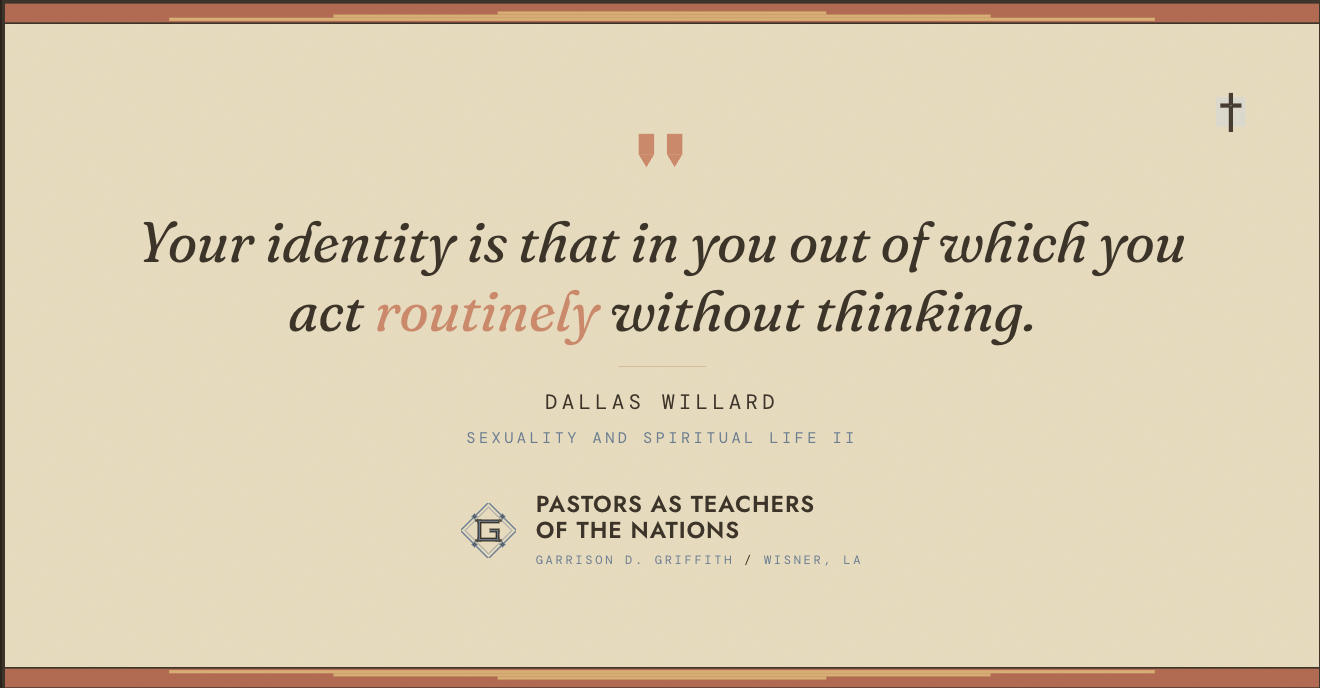
Willard defines identity carefully. “Your identity is that in you out of which you act routinely without thinking.” And then: “Identity reaches to the depths of the person and it indicates ways of acting that are consistent with that identity.” Measured against that definition, sexual orientation makes a thin foundation for a self. Willard asks: “Suppose now that’s the whole deal. What does it tell you to do? Not much of anything except certain kinds of genital behaviors.” A self built on sexuality cannot tell you how to be honest, how to be compassionate, how to follow Christ. It is, in Willard’s words, “pretty thin gruel.”
This is why his question to the distressed young person is not a trap but a rescue. “How much is there to you other than your homosexuality?” He is not minimizing the person’s experience. He is refusing to let a culture that “blows sex up into such a big thing” hand a staggering young person a ready-made identity that cannot hold the weight of a life.
Willard grounds all of this in Scripture that goes deeper than the culture war. “Sex is a passing mode of human union,” he says, pointing to Jesus’ words to the Sadducees about marriage and the resurrection. And he reads Isaiah 56, the foreigner and the eunuch given a name in God’s house “better than that of sons and daughters.” Willard calls it “breathtakingly anti-cultural for that day.” The person the ancient world counted as cut off, dried up, outside the line of belonging, God gives an everlasting name. The conclusion Willard draws is direct: “You are a whole person before God regardless of sex and marriage.”
Hold this together with the clarity of the previous section and you have the whole of Willard’s pastoral ethic here. Sexual sin is real. The relenting will places a person in violation of God’s good order, and Willard does not soften that. Homosexual practice, cohabitation, the whole “hooking up” culture, these damage people and hinder the kingdom life, and a pastor who pretends otherwise has failed to teach. And at the very same time, no person is reduced to their sexual history or their orientation. The man who confesses pornography, the couple living together, the young person who has just named an orientation, each one is a whole person standing before God, to be loved and taught and never treated as less-than while they bring their sexuality into the way of Christ. Willard holds both with no contradiction, because he has rooted identity in Christ rather than in appetite.
That is the kingdom frame. Willard says it plainly: “We need to deal with the general problem in the light of the Kingdom of God and discipleship.” Not in the light of the latest battle over ordination or marriage law, important as those decisions are, but in the light of a King whose reign reorders every appetite and gives every person a name.
A note for pastors:
Our task here is to teach, and Willard means something specific by the word. Proclaiming a behavior wrong from the pulpit is the easier half, and plenty of pastors manage it. Teaching is the harder half: the specific instruction that shows a believer how to live the with-God life in the body he has. Willard says it to the room without flinching: “Now, folks, this is going to be very demanding on your preaching and teaching to do this.” The demand is the concrete part, handing your people a way to live before the crisis ever arrives.
So teach the three-part distinction as a tool your people can use, not a concept they can admire. Give them the sequence in plain words: a thought arrives unbidden and is not sin; an inclination joins it and now there is temptation; the will consents and now there is sin. Then teach what to do at each step. When the thought comes, name it and decline to entertain it. When the inclination pulls, move the body, change the room, tell someone, put a Philippians 4:8 object in front of the mind on purpose. People carrying years of false guilt need the line drawn and the next move named.
Teach identity as something trained, not announced. Willard defines it as “that in you out of which you act routinely without thinking,” which means it is built by practice. Give your people practices that build it: a morning that names whose they are before they reach for a phone, a standing question at the end of the day about where they acted out of Christ and where they acted out of appetite, a place of service that proves their life is larger than any one appetite. A congregation drilled in those habits has somewhere to stand when a young person finally says out loud what he has carried alone.
And when you sit with a believer working out of a sexual sin, teach, do not only counsel. Counseling listens. Teaching hands over a way to live. Give him a rule of life that names the other dimensions Willard says a self is made of: work, friendship, worship, service, and the body’s ordinary care in sleep and food and exercise. Sexual formation does not happen by staring at the sexual struggle. It happens as the whole person is put back under the reign of Christ, one practiced dimension at a time. Teach that to people who are not yet in trouble, and you will have done the work this lecture asks of you.
For Reflection
Willard says many serious Christians suffer because they cannot tell a thought from a temptation, and a temptation from a sin. When your people confess to you, are you helping them locate where the will relented, or are you letting them carry guilt for thoughts they could not control? When did you last teach the distinction as a practice your people could use, instead of only naming it from the pulpit?
Willard asks the distressed young person, “How much is there to you other than your homosexuality? Is that all?” The same question exposes anyone who has built a self on a single appetite. Where have you let your people, or yourself, locate identity in something too thin to carry a life? What would it take to teach your congregation to find their identity in Christ before they are ever in crisis?
Willard insists you are a whole person before God regardless of sex and marriage, and in the same breath he refuses to call sexual sin anything other than what it is. When you sit with someone in a sexual struggle, do you hold both, the dignity and the clarity, or do you drop one to protect the other? What changes in your church if every person is taught they are whole before God while they bring their sexuality into the way of Christ?
So so good…thank you for sharing and making available Dallas’s teaching via YouTube and transcript!
I really have this supplements, pastors with useful approaches