


Pastors are busy people. Ask one how he’s doing (my self included), and the answer is almost always the same: Busy. We wear it like a badge of honor. Dallas Willard heard it like a symptom of a spiritual sickness.
We fill our days with meetings and hospital visits and sermon prep and phone calls and committee agendas and text threads and counseling sessions and the hundred small demands that make up the texture of vocational ministry. And most of us, if we are honest, have arranged our lives so that there is almost no moment in the day when we are alone, quiet, doing nothing.
Dallas Willard saw this as a problem. Not of schedule management, but of spiritual formation. In his sixteenth lecture from the Fuller Seminary course on Spirituality and Ministry, he turns from the philosophy of disciplines to a specific practice he considers foundational: solitude and silence.
You can watch the full lecture or read the transcript here: Solitudet and Silence — Conversatio Divine
Up to this point in the course, he has laid the theological groundwork: the gospel of the kingdom, the nature of ministry, the VIM model, the body’s role in formation. Now he asks a different question: What does it look like to practice a spiritual discipline? And he starts with the one most pastors avoid.
The Radical Cure of Entanglement
He classifies the spiritual disciplines into two categories: disciplines of abstinence and disciplines of engagement. Solitude and silence fall in the first category. They are practices of not doing, of stepping away from what normally fills our days.
Disciplines of abstinence, he explains, help us deal with “things that come to hold a place in our lives that eliminates other things that need to be there.” For pastors, the thing that often holds too much place is other people. Not because relationships are bad, but because our dependence on them, on being needed, being helpful, being available, has become disordered.
Solitude, he teaches, is “electing to step free from human relationships for a lengthy period of time in isolation or anonymity.” It is choosing to be alone and to do nothing. “Solitude is designed to totally take us off of what we do.” And the point of it is, in his memorable phrase, that “solitude is the radical cure of entanglement.”
Entanglement. Most pastors are not just busy. They are entangled. Caught in a web of expectations and obligations and relational dynamics they cannot see because they never step far enough away to get a clear view.
When you practice solitude, he says, you learn something every pastor needs to know but few believe: “If we don’t show up the world will go on and God will take care of it, and other people will be able to serve as well as we.” A hard sentence for a pastor to hear, and a necessary one.
Turning Loose
Willard connects solitude to the practice of Sabbath. Sabbath, he teaches, is “a tremendous discipline — primarily a discipline of turning loose.”
He draws on the Old Testament Sabbath laws (Exodus 23:12, Deuteronomy 5:14) and offers this paraphrase: “You turn your donkey loose; you turn your undocumented labor loose. Just turn it loose, that’s the law of the Sabbath.”
The donkey represents all the labor and productivity we depend on. The Sabbath command is not to stop working. It is to release your grip on the things that work for you. To trust that God’s provision will hold even when your effort stops.
He presses the point: “Most people aren’t able to practice that unless they have learned to practice solitude.” Sabbath requires you to trust that God holds the world without your effort. Solitude is where you learn that trust in small doses. You cannot turn loose for an entire day if you have never practiced turning loose for an hour. Sabbath is the fruit of a life that has learned, through the regular practice of solitude, that God does not need your productivity to run the world.
Solitude is also a place of restoration. He points to Elijah, exhausted, afraid, running from Jezebel, and notes that God’s first prescription was not a sermon or a strategy session. It was sleep. It was food. It was solitude. “Solitude is a place of restoration.”
For the pastor who has been running on fumes and adrenaline, that is an invitation.
Finding The False Self in the Quiet
Solitude is hard. It is hard because it forces you to meet someone you have been avoiding: yourself.
“The false self,” he explains, “is basically a way of presenting yourself to others, partly because of demands that you feel are being made upon you, but they don’t really represent who you are.” Pastors know this. There is the person you are in the pulpit, the person you are in the committee meeting, the person you are when a church member needs you to be strong. Adapting to these contexts is not the problem. The problem is when we can no longer tell which version of ourselves is real, when the performance has replaced the person underneath it.
He names the mechanism: “Constant interaction with others becomes a way of being pre-occupied and not really dealing honestly with ourselves, and who we are, and what we are to do.” We stay busy, in part, because busyness protects us from the quiet where the false self cannot survive. In solitude, he says, “you don’t need to fool anybody.”
That is uncomfortable. But as the false self dissolves in the quiet presence of God, what remains is who you are. A person beloved by God, called by God, sustained by God, regardless of what you produce.
Silence Is Not an Absence. It Is a Presence.
Willard distinguishes between solitude and silence, though they are close companions. Silence, he insists, is more than the absence of noise. “Silence is not an absence, it’s a presence.”
That is a theological claim, and he means it. The God who spoke creation into being is present in silence, not absent from it. “Be still, and know that I am God” is not a command to relax. It is a promise that the God who is already there can be known when we stop filling the space with ourselves. Silence, practiced with intention, opens us to this reality that the noise of daily life conceals. In silence, he says, “we are able to experience eternity.” Not emptiness. Fullness. The kind we cannot hear over the constant chatter of our own voices and the voices of others.
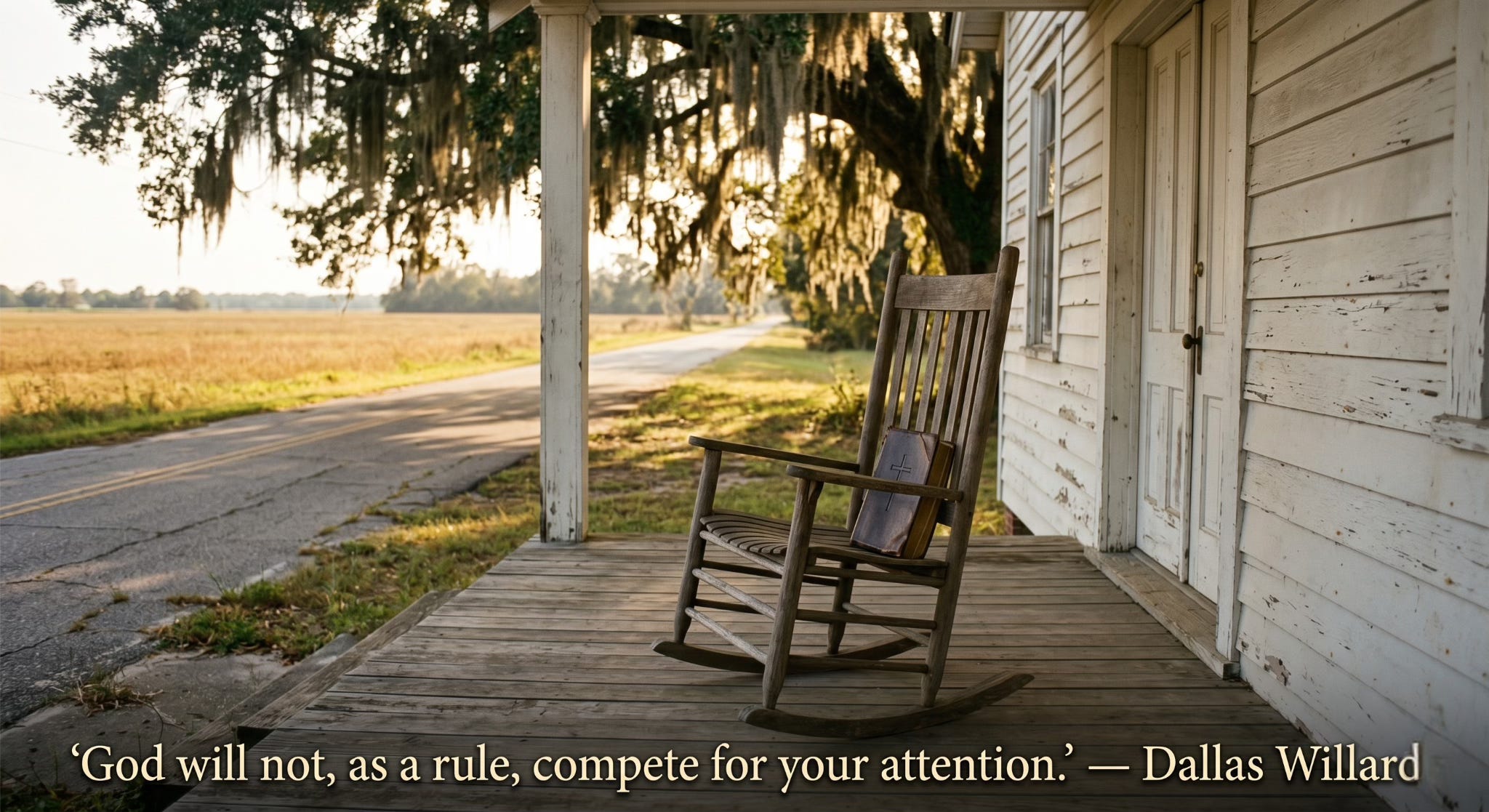
“God will not, as a rule, compete for your attention.” He will not shout over our noise. If we want to hear, we will have to get quiet.
The specific discipline he has in view is not being in a quiet room. It is the practice of not speaking. And the reason it matters is precise: “When you refrain from speaking, you lay down the burden of adjusting how you appear to other people.”
Every pastor knows this burden. You adjust your words for the deacon who is upset, for the visitor who might come back, for the family in crisis, for the colleague who needs encouragement. The tongue, as James says, is close to the will, and it runs on without our knowledge of what is good. In silence, you lay that burden down.
Solitude and silence together break the power of hurry. And hurry, he notes, “is a kind of attitude that combines, usually, guilt and fear, and an excessive sense of you.” When these practices become part of the pastor’s life, they form a person who acts from rest rather than compulsion. From trust rather than anxiety. From allegiance to God rather than fear of failure.
This is not willpower. He is clear: “Willpower itself is exhausting and if you have to live by willpower, it will get the best of you eventually.” Solitude and silence are not tests of endurance. They are practices of surrender, the slow, grace-enabled work of becoming the kind of person who does not need to be in control.
There is a gift hidden in the practice. He offers this promise: “Solitude is something that, when you practice, you can have it wherever you are. That’s a benefit of solitude.” The person who has learned solitude carries it into the committee meeting, the hospital room, the pulpit. They are present in a way the hurried pastor never can be. They have learned, as the psalmist writes, to “set the Lord always before me,” and to find that he is enough.
For the pastor who, as a teacher of the nations, embraces the Willardian paradigm, these practices are not to be proclaimed and taught from a distance. They must be manifested. Solitude and silence must be integral to a pastor’s personal practice. These disciplines shape pastors into the kind of people who embody the realities of the kingdom while serving within it. You cannot teach what you have not practiced. You cannot lead people into the quiet if you have never been there yourself.
For Reflection:
Willard asks his students: “How do we seek the face of God? How do we come to the place to where He is before us?” What is your honest answer? Do you have a practice that brings you there, or are you running on theological knowledge without personal experience of the quiet?
Willard challenges: “If you have too much to do, it’s not God’s responsibility, it’s somebody else’s, and you might work on that, as to whose it is.” Whose responsibility is the pace of your life? Have you turned your donkey loose, or are you still gripping the reins?
Are you teaching your people the practice of solitude and Sabbath from the overflow of your own experience, or are you proclaiming a rest you have never entered?
I am so thankful for your posting using Dallas Willard as your foundation. I am so very blessed. I wish I could hug you.
Love! :)