


“What would it be like to have someone prepared to teach people to do the things that Jesus said?”
Are you prepared for such a thing? Am I?
Most of us were trained in ministry to preach about the things Jesus said. Few of us were trained to teach people how to actually do them. That may account for much of the quiet frustration in the modern pastorate. We produce congregations who can tell us what is right, but have little ability or interest in doing what is right. We tell them what Jesus taught, urge them to obey, and then watch them fail at it on repeat — and wonder why our people are exhausted and why we are, too.
Willard’s helps us understand that the problem is not that our people are insincere. The problem is that nobody ever trained them. And the reason nobody trained them is that most of us were never trained ourselves. We need a reeducation in the ways and means of spiritual formation.
This lecture is where Willard hands the pastor the framework to change that. He pivots his whole course from ministry philosophy to ministerial practice, and he does it by unfolding three gifts that the rest of this essay will trace: a refusal to let us treat formation as optional (everyone is already being formed), a refusal to let us pursue obedience by willpower (obedience comes by indirection), and an ordered pattern — Vision, Intention, Means — that the pastor can actually build a ministry around.
If we cannot yet do what Willard is asking of us, this is the lecture that teaches us how to begin.
You can watch the full lecture or read the transcript here: Spiritual Formation and the Disciplines.
Everyone Is Being Formed
The first thing Willard wants his students to understand is that spiritual formation is not an optional program the church adds on for interested parties. It is not a track for the spiritually serious. It is happening to every person in your congregation, and to every person outside it, every hour of every day.
“The spiritual formation you had is responsible for the life you are now living.”
Everyone arrives at the present moment as a product of the formation that preceded it. Your deacon was formed. Your teenager is being formed. The couple who wandered in on Sunday morning has been under formation their whole lives — by their parents, their marriages, their work, their entertainments, the algorithms they feed every night before sleep. The question is never whether your people are being spiritually formed. The question is by what.
This reframes the pastoral task. The pastor is not trying to start formation in people. The pastor is trying to name the formation already at work in them — and to offer them a different course of action.
Obedience by Indirection
Willard, in a way that only he can, takes the whole project of Christian obedience and sets it at an angle to how most of us pursue it.
“The real issue in spiritual formation is obedience, but you don’t go there directly. You go there indirectly.”
Try this out on a Monday morning in your own life. Preach Sunday on patience. Wake up Monday with every intention to be patient. By 9:15 you have snapped at your wife, muttered at a driver, and been short with a deacon who stopped by the church office. You tried to be patient by direct effort and you failed. You will try again next week and fail again. This is the cycle our people live in continually.
Willard’s diagnosis is not that you lacked sincerity. It is that you lacked training. You cannot produce on the spot what has not been formed in the body over time. As he puts it:
“Indirection is where you get somewhere by going somewhere else.”
You do not reach patience by gritting your teeth on Monday morning. You reach patience by practicing solitude and silence, study and service, fasting and prayer — activities that address the underlying person who is reacting impatiently. A spiritual discipline, Willard says, is
“an activity within our power that enables us to accomplish what we cannot do by direct effort.”
The Golden Triangle is the picture of how this works. At the top is the action of the Holy Spirit. At the bottom-left are the ordinary events of life — most often experienced as temptations. At the bottom-right are the spiritual disciplines. All three converge on the center: the transformation of the whole person into Christlikeness.
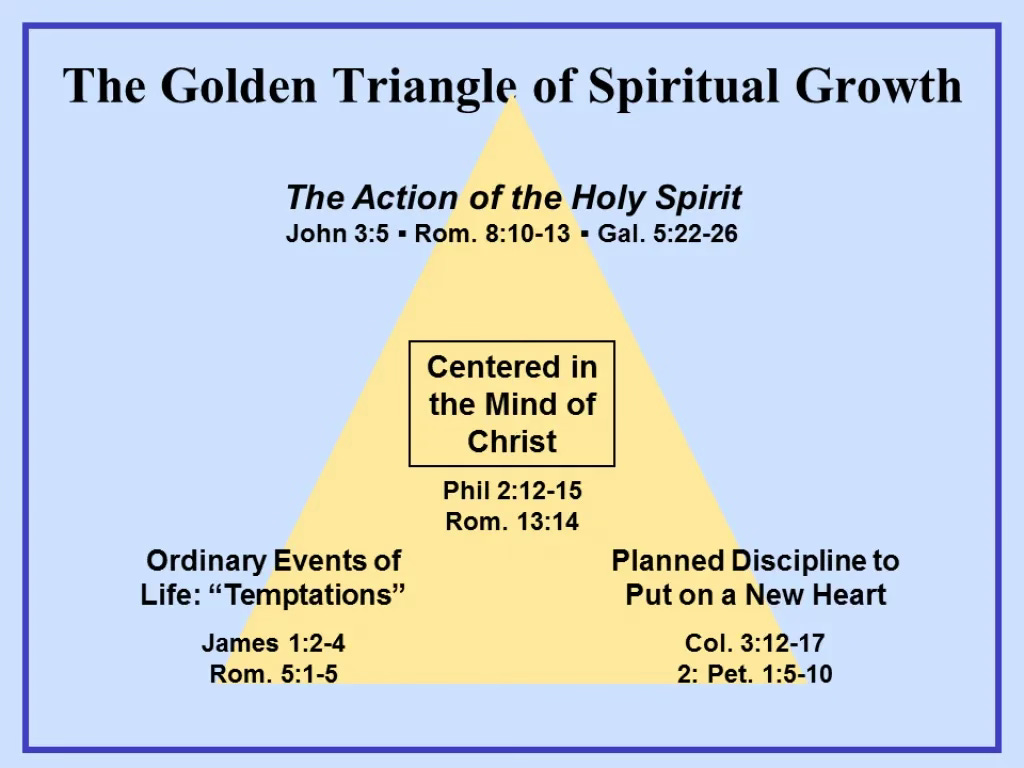
Notice that none of the three vertices functions alone. The Spirit works through events and through disciplines. Events test the formation the disciplines have done. The disciplines train the person who will meet the next event. A pastor who preaches the top vertex and ignores the bottom-right produces Christians who are exhausted from trying to do by willpower what only a trained life can do.
Grace Is Not Opposed to Effort, But to Earning
This next line of Willard’s is the first one that ever stuck with me. I had been handed the standard evangelical gospel - don’t go to hell, and don’t let anyone else. Then Willard I read where Willard wrote this:
"Grace is not opposed to effort but to earning. Earning is an attitude. Grace is opposed to that."
The whole center of faith shifted for me. Effort was not the enemy of grace. Effort was the shape of a life that had already received it. My life meant something today not just for eternity.
Paul says the same thing in Romans 6. The one who has received grace from above is no longer a slave to sin but a slave to righteousness. The person who has been raised with Christ does not work to earn God’s favor. They work because they have already received it and now belong to a new Master whose way is life.
Willard is not sentimental about this. He is blunt:
"The single most obvious trait of those who profess Christ but do not grow into Christlikeness is their refusal to take the reasonable and time-tested measures for spiritual growth."
The thing most obviously missing in the life of a stagnant Christian is not more teaching, more passion, more experience. It is their unwillingness to take up the practices that Christians have been taking up for two thousand years. It is the unwillingness to put any effort into their spiritual walk. The disciplines are the reasonable and time-tested measures. A pastor who will not practice them is not well positioned to lead anyone into them.
Vision, Intention, Means
Willard ends the lecture with the pattern that organizes his whole vision of formation. He calls it VIM.
Vision — a clear picture of life in the kingdom of God and your place in it.
Intention — the deliberate decision to realize that vision by becoming Jesus’ apprentice.
Means — the specific practices and disciplines that train you to live what you have intended.
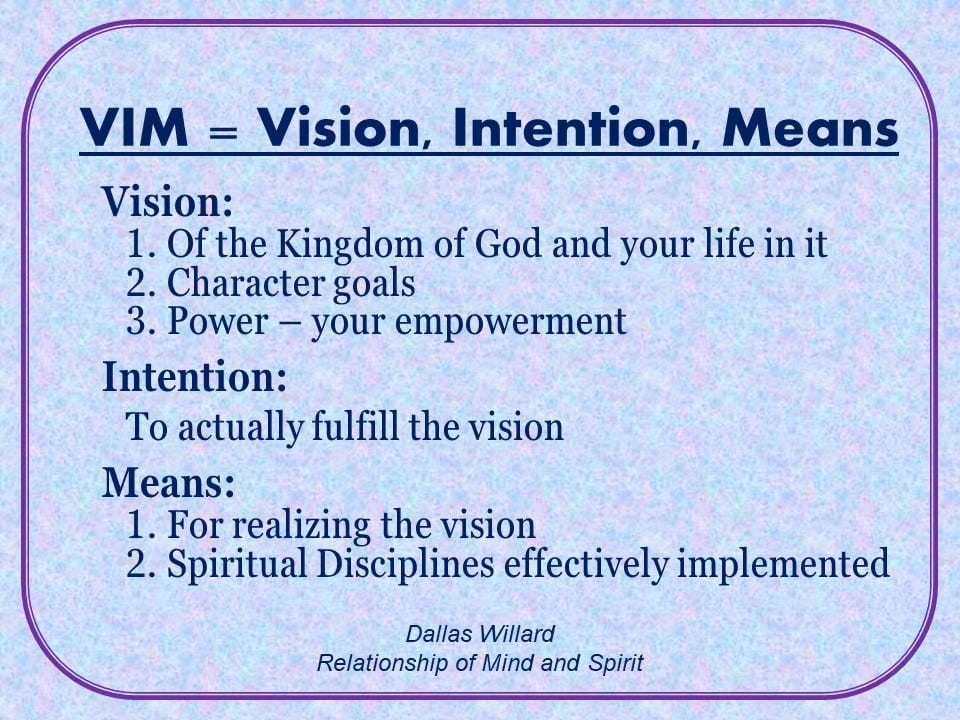
The three must be held in order. Vision first. Intention second. Means third. Willard warns that most churches default to Means. We hand our people the practices — read your Bible, pray, get to church, join a small group — without ever establishing the Vision of kingdom life that would make those practices desirable, or the Intention to be Jesus’ apprentice that would make them durable.
The result is the cycle of failure every pastor recognizes. Your people try a habit or new way of living for three weeks and drop it. You chalk it up to their lack of discipline. Willard would tell you the problem started much earlier. You handed them Means before they had Vision. You told them what to do before they had seen why anyone would want to.
The gift Willard gives the pastor is an order of operations. Preach the kingdom first until your people can see it — until they want to live there. Then invite them to intend that life — to say yes to being an apprentice of Jesus. Then, and only then, hand them the practices. You will find the practices stick because they are now carrying a Vision and an Intention, not floating alone.
Spiritual growth, Willard reminds us, "does not happen passively" but requires "well-directed effort." The pastor’s task is to direct the effort through proclaiming, teaching, and manifesting the kingdom.
For Reflection
I’ll let Dallas’s questions from the lecture guide our reflection:
“What would it be like to have someone prepared to teach people to do the things that Jesus said?” Are you that person in your church? If not, who is?
“Could we do that?” Could your church, as it is currently structured, actually form apprentices of Jesus — or is it structured to produce attenders?
“Can you not do it?” Where in your own life are you still trying to obey Jesus by direct effort, and what discipline of indirection would Willard send you toward this wee
I am incredibly grateful to have been led this content. It make so much sense to understand what I have never been taught how to grow in my relationship with Jesus.
Beautiful….Vision is EVERYTHING, and Vision is ULTIMATE. Sadly, most of us Christians do not or have not know, and or, have not been shown what God’s Vision is for us.
Dallas’s teachings are life changing, but it’s only through the gift of God’s kindness and mercy for each one of us to truly see this!
Blessings Everywhere:)!!❤️🙌🙌❤️