


May the mind of Christ my Savior live in me from day to day, by His love and power controlling all I do and say.
May the word of God dwell richly in my heart from hour to hour, so that all may see I triumph only through His power.
May the love of Jesus fill me as the waters fill the sea, Him exalting, self abasing — this is victory.
Dallas Willard opened his fifteenth lecture at Fuller Seminary by asking a room full of doctoral students to sing those words together. Pastors, ministry leaders, people with years of preaching behind them, singing a prayer about transformation before anyone said a word about theology.
Then he led them through a slow, reflective exercise on the Lord’s Prayer. The version where you stop and stay. “Our Father...who art...in...Heaven,” he modeled, putting thought into each word, giving it time. “I don’t rush on,” Willard told them. “Sometimes you may not go on; you just find such a rich place there that you just want to stay there.”
He admitted that he grew up saying this prayer every morning at breakfast. “I am very thankful for that, to tell you the truth, but we didn’t think much about it. We just sort of ‘got through it.’” The better use, he said, is to take it meditatively. “When I first began years ago to learn how to use this, I often couldn’t finish it because I would get into one of these phrases and I would just luxuriate there and that’s okay.”
Willard was doing spiritual formation in this course, not talking about it. Through singing, prayer, and meditation, he gave his students tools they could take back to their own congregations, tools for leading people into the realities of the kingdom through embodied practice. Pastors are training people in practices that help them participate in the kingdom in the present. He was showing them how.
You can watch the full lecture or read the transcript here: The Body and Habits in Spiritual Disciplines, Conversatio Divina
The Body Is Not the Enemy
If you grew up in church, you absorbed, whether anyone said it this directly or not, a suspicion of the body. The body is where temptation lives. The body is what gets you into trouble. The body is the thing the spirit must overcome.
Willard names this assumption and dismantles it. The body, he tells the class, “is meant to be the main support of practical holiness, of life in the Kingdom of God with Jesus. It’s the body.”
Willard starts with a basic description: “Body is potential energy.” Kinetic energy is something in action. Potential energy is something that can be called into action. “We are given a body by God in order that we might act.” It is made available to us so that we might live and love and create, and so that we might defy God if we choose. “That is important to our becoming a person,” Willard says. Our capacity for rebellion is part of the architecture of personhood. “I become a person with a Kingdom by means of my Body. That’s the only way I can do it.”
And then: “It’s my little personalized Power Pack.”
The body is also, in its current condition, tangled up in patterns that run against the grain of the kingdom. “In our fallen world, our body takes on a system of tendencies away from or against God,” Willard says. And he is clear about what conversion does and does not do: “Conversion does not wipe out the tendencies that are wrongly directed and built into our body.” These tendencies persist in our reflexes, our cravings, our automatic responses, our grooved patterns of anxiety and self-protection. “If you are going to break that, you have to break those habits.”
Conversion alone does not produce Christlikeness. The body must be retrained.
Why Peter Denied Jesus
Willard offers Peter’s denial as the case study.
Peter loved Jesus. Peter meant every word when he said he would never deny him. But Willard points out that Peter “was thinking in terms of his intentions as he understood them and he had no way of understanding how his emotions and his physical isolation and weariness and being scared to death of death and so on, how that was going to affect him.”
When the pressure came, Peter did not make a decision. His body made it for him. “That was what was in his body. He didn’t have to think about it.” His intentions said one thing. His habits, forged in a lifetime of self-preservation, said another. The habits won. They always do, until they are reformed.
The good news in Peter’s story is that the breakdown came fast. “Partly because of what Jesus had told him and now he is thinking about it and he remembers that Jesus said, ‘You are going to deny me three times.’” Peter gained, Willard says, “a deeper self-knowledge.” You see that self-knowledge surfacing again and again in Peter’s life, most strikingly when Jesus tells him to go fishing, he hauls in the massive catch, and falls to his knees: “Lord, depart from me, for I am a sinful man.”
Peter’s denials were a failure of formation, not devotion. His heart was willing. His body had not been retrained.
Love and Want Are Not the Same Thing
Willard pauses to make a distinction that cuts to the heart of pastoral work.
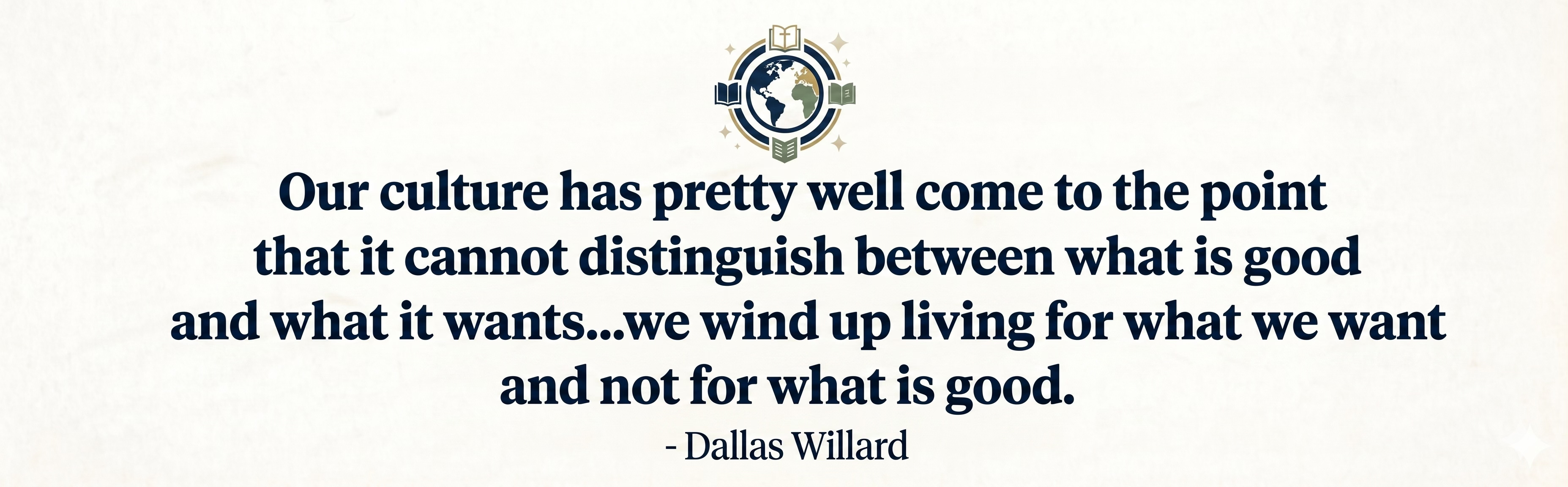
“Our culture has pretty well come to the point that it cannot distinguish between what is good and what it wants,” he tells the class. “Then we wind up living for what we want and not for what is good.”
He illustrates with characteristic humor: “People say that they love chocolate cake but they don’t love chocolate cake, they want to eat it and that’s different from loving it. Now, you can imagine someone who loved chocolate cake; they just took good care of it and saw to it that it was in the best condition and so on. That’s not what people have in mind, right?”
The room laughs, and then it gets quiet. “The difference between loving and wanting is absolutely profound,” Willard continues, “and when you come to things like ‘love your enemies’ or ‘your neighbor,’ you have to know what love is or you can’t go there.”
The body’s desires are not wrong in themselves. “Human beings couldn’t live without desire. No child would survive except for their desires.” But desire must be subordinated to what is good rather than exalted as ultimate. That subordination does not happen by wishing. It happens through training. The body is where the training takes place.
The Flywheel of the Spiritual Life
To explain how retraining works, Willard turns to philosopher and psychologist William James.
James spent years thinking about how habits live in us. His answer is through what he calls plasticity: “the possession of a structure weak enough to yield to an influence but strong enough not to yield to it all at once.” The body is built to change. But it does not change all at once. It changes through repetition, through the slow accumulation of small actions that become automatic.
James’s most important sentence, the one Willard highlights for his students, is this: “Habits depend on sensations not attended to.”
“You won’t ever learn anything more important about all this stuff than what that sentence says,” Willard tells them. Habits are governed not by our conscious decisions but by sensations operating beneath our awareness, the cues and feelings we do not notice but that direct our actions moment by moment. Peter did not attend to the sensations that were going to govern his action when the servant girl asked if he knew Jesus. “The process of spiritual growth largely comes in having enough space to be able to recognize what is going on,” Willard says, “and often those are mere feelings.”
James offers a metaphor Willard loves: “Habit is the enormous flywheel of society, its most precious conservative agent.” A flywheel is a large, heavy wheel that stabilizes the motion of a machine. It looks like it is sitting there spinning. But it is regularizing the entire operation. Habit does the same thing in our lives. It stabilizes us, for good or for ill.
The practical claim follows: “The great thing then in all education is to make our nervous system our ally instead of our enemy.” The nervous system, the body, the habits that run beneath our awareness, these are either carrying us toward the kingdom or away from it. The disciplines are the means by which we make them our ally.
James is blunt about what this requires. No tapering off. No half-measures. “Seize the very first possible opportunity to act on every resolution you make,” he writes. “It is not in the moment of their forming but in the moment of their producing motor effects that resolves and aspirations communicate the new set of the brain.” If it does not get to your body, it will not govern your life. Intentions that never reach the muscles remain intentions.
John Stuart Mill captured the endpoint: “A character is a completely fashioned will.” A will is “an aggregate of tendencies to act in a firm and prompt and definite way upon all of the principal emergencies of life.” A will so trained that right action flows from it in the emergencies and in the ordinary moments alike.
Paul knew this. “Put off the old person,” he writes to the Ephesians, “and put on the new” (Eph 4:22–24). To the Colossians: “Put off the old self with its practices and put on the new self” (Col 3:9–10). The language is bodily. It is the language of clothing, of physical action, of doing something with your limbs and hours and habits. And it is the same language Willard uses when he quotes Romans 13: “Put ye on the Lord Jesus Christ and make no provision for the flesh to fulfill the lust thereof.” The spiritual disciplines are how the putting-off and putting-on happens. You cannot direct your emotions. You cannot direct your desires. But you can direct your body. And through how you use your body, transformation occurs.
Conditions, Not Actions
Willard turns to 2 Peter 1 to show what this fashioned will looks like in Scripture. Peter lists the qualities of a kingdom-formed life: faith, virtue, knowledge, self-control, perseverance, godliness, brotherly kindness, and love (2 Pet 1:4–8).
Willard walks through each one. Faith needs virtue: “virtue that is not based on knowledge is very weak and wobbly and it won’t stand up well.” Knowledge needs self-control. Self-control needs perseverance: “You don’t want self-control on Tuesdays, Thursdays, and Saturdays. It’s seven days a week.” And agape always comes out at the top.
Then Willard says: “There is not a single action mentioned. The things that are listed are not actions.”
“Actions will, by and large, take care of themselves. You focus on the condition, and this is a list of conditions, not actions. And this is the righteousness that lies beyond the righteousness of the Scribe and the Pharisee.”
We build our ministries around telling people what to do, the right behaviors, the right moral performances. Willard says focus on the conditions. Cultivate the character. The actions will follow. These conditions do not stack on top of each other like blocks. “They interweave, they mesh with one another,” Willard says, “and it is as you bring them together that you begin to see.”
For the pastor, the question is direct: “What’s your plan? How do you do this?” These writers, Willard acknowledges, “tend to tell us what needs to be done but they don’t go into the details of how you do it.” That is the pastor’s task. Teach people not just what a kingdom-formed life looks like, but how to move from faith toward virtue, from virtue toward knowledge, from knowledge toward the love that holds it all together.
Why Would God Set Things Up This Way?
Near the end of the lecture, Willard asks: “Why would God set things up that way?”
He does not answer the question head-on. He says we need a theology of it, that “a lot of people’s faith is very weak because they don’t understand why God has arranged things this way.” The implication is clear: God made us embodied creatures because embodiment is how persons are formed. The body is the means by which we become who we are.
Willard’s grandmother was living proof. She was a woman for whom the worst words she could think or say were “shucks” and “tobaccer.” Her habits, mental and verbal and bodily, had been shaped so that certain things were not available to her. “There were just a lot of things that she couldn’t think.”
That is formation. It is what happens when the flywheel has been spinning in the right direction for a long time.
Keith Matthews offered the class the phrase that ties all of this together: “Spiritual disciplines are more related to wisdom than righteousness.” The disciplines are the practical wisdom by which we cooperate with God in the retraining of our personalized power pack, so that the body becomes what it was always meant to be: the main support of practical holiness, of life in the Kingdom of God with Jesus.
For Reflection
Willard says “conversion does not wipe out the tendencies that are wrongly directed and built into our body.” Where are those unreformed tendencies still running in your life, the automatic responses of anxiety, self-protection, or compulsion that your conscious intentions have not caught up to? What would it look like to “seize the very first possible opportunity” to act against them?
Do you treat the body as an obstacle to spiritual growth, or as the God-given “personalized power pack” through which growth happens? If you are a pastor, how does that assumption shape the way you teach your people? If you are not, how does it shape the way you pursue your own formation?
When your church teaches spiritual disciplines, are they presented as wisdom for kingdom living, or as duties you ought to perform? Has the foundation of Vision been laid before the Means were handed out?