


“If you were to die tonight, where would you be?”
The question comes out of a generation of evangelism training. It sat at the front of Evangelism Explosion, and it asks a man to face his own death and settle where he stands with God.
Keith Matthews set another question beside it on the same chart.
“If you knew you could live forever, what kind of person would you like to be?”
Keith compared these questions because the two aim at different things. The first aims at a destination. The second aims at a person and their life today. Dallas Willard wanted this gospel in the pulpit because he wanted congregations equipped to grow as apprentices of Jesus.
This is Lecture 30 of Willard’s Fuller series, the session after Keith took the practical hour. Keith stays at the board long enough to map what a conversion-only gospel does to a body of believers. Then Willard takes the floor. You can watch the full session or read the transcript here: https://conversatio.org/the-cycle-of-two-gospels/?collection=2409
The gospel in its fullness gives us an answer to both questions. Christ forgives us and receives us, and He calls us into a new kind of life that starts now. Preach only the forgiveness and a cycle starts, one that fills a church with Christians who believe they have already finished. Preach the whole of it and a different way of life becomes available, one that fills a church with disciples who train for a life of righteousness.
The Conversion-Only Gospel Runs a Cycle
Keith is talking to evangelicals, and he says so. Scot McKnight had described three streams of initiation in the church: personal decision in the evangelical stream, socialization in the mainline, liturgical acts among Catholics and Orthodox. Keith is working with the first, because that is where the majority of the students present came from. “A conversion gospel is one that you need to come to Jesus, in order to be forgiven of your sins so you can go to Heaven.” Simplification, he admits. Then he asks what the model produces when the transaction is done: a Christian.
Becoming a Christian is a good thing to become. The word is meant to be a picture of a person. Luke reports the name starting in Antioch, and starting with outsiders, and commentators read it as a jab. “You little Christ.”
Evangelicals give the word at a moment of prayer, while the life is still ahead of the person. So it comes to mean a settled account rather than a new life. “Once you’ve prayed the prayer, essentially, you are done.” Bring discipleship later and the honest reply of the converted may become: “If I’ve prayed and received Christ and am going to Heaven, why do I need to do that?”
Passivity is what this cycle tends to produce first. We tell people to come to church and read their Bibles. The gospel we preached to them already settled the account, so they hear the asking as optional. We preach harder at their passivity but give them no purpose for practicing their faith. They are left to try this or that, and never given a picture of what life as a disciple of Jesus looks like.
Trying is bare intention. Keith draws the chain out at the board. “Trying is dying and trying equals failure and what happens after failure? Where does failure go? Guilt.” Willow Creek Church offers a warning. They ran the experiment and published what they found. Get a commitment to Christ, get people into a small group, get them busy and committed, and growth was supposed to follow. Keith puts their Reveal study up in the class, the 2007 self-audit of their own discipleship. “Guess what The Reveal Study said? All of those things... did not make somebody a mature disciple.” Their vision was mature disciples. Their programming and their measurement both tracked activity, so activity is what the system got good at producing. A church can run every program well and still turn out people who have been kept busy but are not disciples of Jesus.
Lecture 9 called this a deficient gospel.
A Disciple Has a Teacher
The other column on Keith’s chart is the whole-life gospel. It produces disciples. The question changes the aim. “If you knew you could live forever, what kind of person would you like to be?”
A disciple is attached to a person, and Keith is careful about whose person. “Again, when I talk about discipleship, I am not talking about discipleship to me.” The attachment runs to Jesus. The operative word on this side is Teacher. Renovaré names four ways we relate to Jesus: Lord, Savior, Teacher, Friend. The conversion column has kept two of the four. Savior comes first. Lord arrives as duty.
“If people relate to Jesus primarily as their Savior, the only time they need Jesus is when they sin or they are in need.” The rest of the week is their own. Teacher is the name that claims those days. “Jesus is their teacher. He is going to teach them how to live life in the Kingdom of God.” We wake up and ask Him how to live this job, this marriage, this day, because He has the wisdom for it.
Training replaces trying. Trying spends itself in the moment of testing, reaching for an action the person is attempting for the first time. Training spends itself in the ordinary week, on things the person can already do, so that the action is within reach when the moment comes. Keith wants this personal and corporate, a church training together rather than a room of people each trying alone. Honesty and brokenness belong in the main room, as the ordinary means of a life that is being taught. Keith’s name for the shift is Sunday to Sunday into Monday to Monday. Formation happens in the job and the family, where the Teacher is already at work.
And the training has a destination. “We’re training for reigning.” God made people to govern, to have a real say over a piece of His world and to run it well under Him. That capacity is what sin cost us, and it is what the training gives back. This gospel moves toward “fulfilling God’s agenda for the world.”
The conversion column aims a person at the next life and leaves this one unused. The whole-life column aims a person at a kingdom that has already arrived, and trains them to live in it until they can be trusted with more. What waits at the end of the training is responsibility, a share in the running of things. The apprenticeship for it is under way now.
Willard Keeps the Conversion
Willard takes the board back and leaves conversion on it.
He points at Keith’s whole-life column and answers the objection. “This does not exclude conversion.” The whole-life gospel keeps the turning. It asks what the turning is for.
He turns to Augustine. “Boy, did he ever have a conversion, right?” A man walks into a garden one person and walks out another, and he spends the rest of the Confessions tracing what changed in his appetites and his friendships. The moment was real, and the decades after it were the proof. Willard wants that, and he wants more of it. What he refuses is one particular account of it. “There is no problem with conversion on these two cases. The problem is that we equate conversion with that magical moment of mental ascent that translates the merits of Christ into our bank account. That’s not the only model of conversion, right? So, remember that.”
Put in older words, this is an argument about where sanctification sits. A forgiveness-only gospel leaves it outside, to be added later. The gospel Willard wanted has it inside from the start.
Belief, on that reduced account, becomes a score. “It isn’t like check that off and you check off a certain number and you get into Heaven. It’s the difference that what we believe makes in our life.” Many people, Willard says, think being right with God is like a driver’s test. Miss three and you are out.
“As a Baptist preacher, I was taught that one of my main businesses was to convince people that they were saved and I really don’t think that’s our business.” He will help the person who is troubled on the point, and he leaves the verdict where it belongs. “What really matters is what went on between God and the individual, right? And we are not really in a position to check that off.”
A person walking in the power of the Holy Spirit and the character of Christ, he says, “ain’t no problem.” The trouble is the culture we built on the other column. “We’ve created a culture where that’s not the standard,” and on that standard “you can be a Christian without doing that.”
A person like that is already living the salvation he would be asking about. The eternal kind of life has started in him, and people who are growing in it rarely lie awake wondering whether they are in or out. That worry grows where we offered a person a transaction, told him the matter was closed, and left him to wonder whether it took.
New Life From Above
Willard opens the floor. “I’d better give you a chance to say something.” The room laughs. “So, say something. Richard, say something.” The rest of the hour belongs to the class.
A student asks about the Spirit’s role.
The Spirit imparts life from above. Baptism, anointing, filling, fruit, gifts: the new life is meant to be surrounded and filled, and “that will not be automatic.” We can grieve Him. We can refuse to cooperate. “Just the fact that you’ve been born again doesn’t mean now, it will be taken care of. You still have to have intelligent engagement, well informed scripturally and you have to act on it and that’s where things like disciplines come in.”
God has determined that human beings “should be responsible for the kind of person they become.” “Without the Holy Spirit?” “No, no, no, not without the Holy Spirit, but if they won’t act, the Holy Spirit won’t do it.”New life is a gift. Who we become is in cooperation with the Holy Spirit.
Another student wants to know how to tell a transformed life from a “social” gospel. Willard rejects the split. “There is no Gospel that is not social.” Loving God and loving a neighbor is one commandment, so everything filed under the social gospel is “simply the outworking” of it. “There is also no social without Gospel. You gonna do social? You better go to the Gospel first.” A conversion-only gospel can leave love of neighbor out of the deal. A life with the Teacher has neighbors in it.
The vision that motivates both columns is John 3:16. Willard reads the verse whole. “God so loved the world that He gave His only Begotten Son that whoever believes in Him would not lead a futile and failing existence but would lead an eternal kind of life.” John 3, he says, “is not about forgiveness of sins; it is about new life from above.” Forgiveness is inside that life.
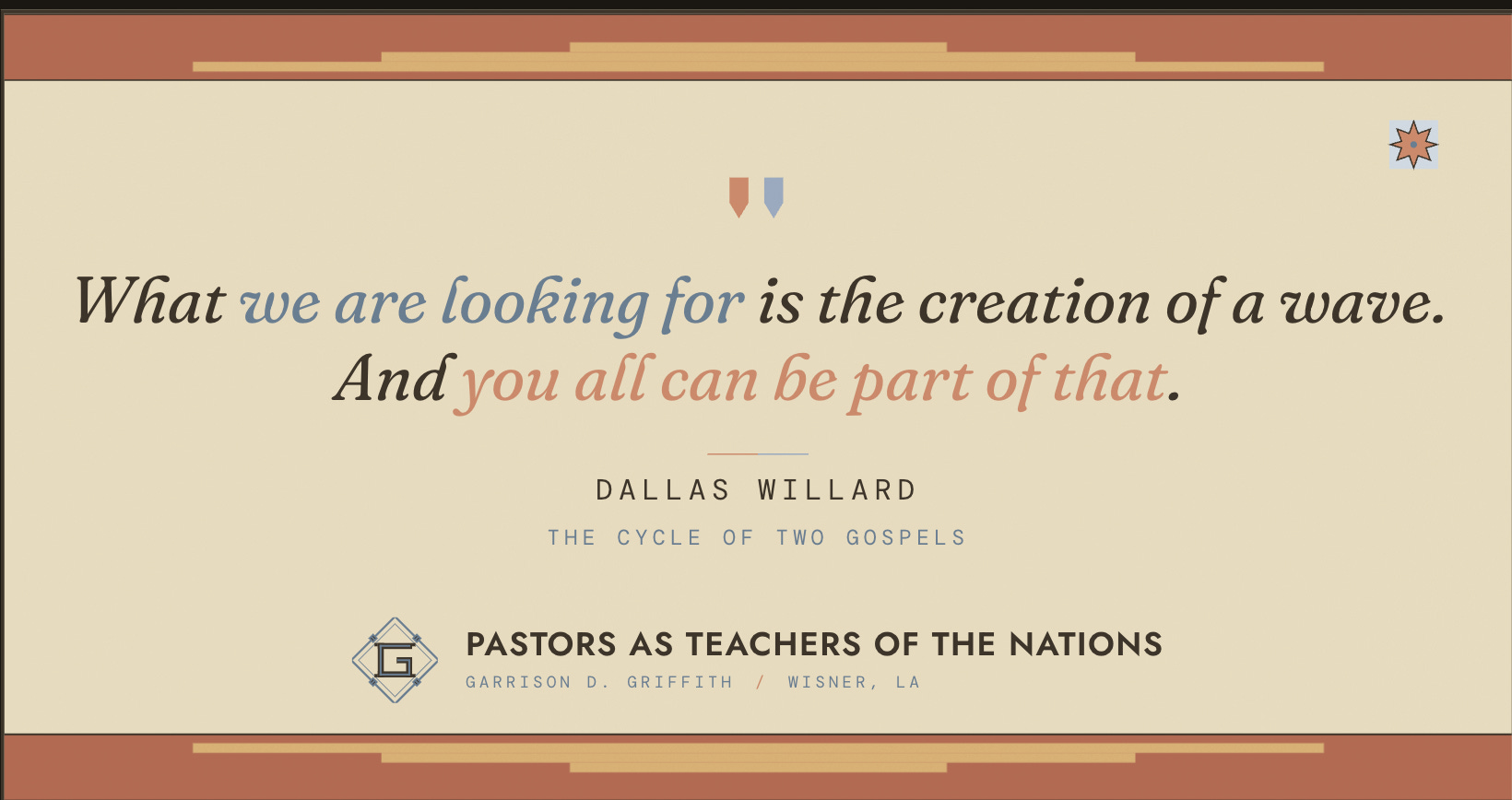
What he wants from the pastors in the room is larger than a well-managed congregation. He wants pastors who teach their people the knowledge of how to live with God, which is what I mean when I call us teachers of the nations. He tells them “what we are looking for is the creation of a wave. And you all can be part of that... a wave of Christ coming evermore fully into the world through people.” The early church became “a wave that nothing could stand against.”
A conversion-only gospel settles a person’s account, then spends the years after managing the guilt. The gospel Willard wanted preached gives that same person a Teacher and from him a way of life to learn. Preach that one, and say out loud from the pulpit what the forgiveness is for, and the people in front of you have somewhere to put their real life when they wake up Monday morning.
For Reflection
Keith asked the class, “If you knew you could live forever, what kind of person would you like to be?” What kind of person is the gospel you preach producing?
Willard said that as a Baptist preacher he was taught to convince people they were saved, and he does not think that is our business. If that is not the job, how does that change what you do week to week?
"What is it that can actually do something about the condition that the world is in?" Willard asked a room of pastors that. What is your church's answer to it?
Thanks for the article and bringing up Dallas Willard’s teachings on discipleship to Jesus. It is very clear that many of the churches has been focus on conversion of their beliefs rather than becoming the kind of person that loves God and our neighbors. I, too have been a part of a church for many years that focuses on converting people’s beliefs and making them active part of the church in converting others to our practices. It is sad to see that I thought I have became mature because I was busy and committed to our cause of multiplying converts. But, the truth is that I have became legalistic and hard on myself in order to obey God’s commands.
May the Lord help us preach the correct gospel of Christ to this generation and the next. Amen!
Thank you Garrison. My mind is fed and my heart is encouraged when I read your posts.