


Ask a room full of Christians for a hard teaching of Jesus, and someone will bring up “turn the other cheek.” It has become the test case, the verse we hold up to measure whether we are willing to do what Jesus said. We treat it as a rule, maybe the hardest rule on the books, and then we spend our energy deciding how far we are required to take it.
In The Divine Conspiracy Willard takes that verse, “They will turn the other cheek,” and refuses to treat it as a rule. These hard sayings, he writes, are “illustrations of what a certain kind of person, the kingdom person, will characteristically do.” They are not laws, and the reason is plain: “they do not cover the many cases.”
Read every command in the Sermon that way, as a picture of the person Jesus is forming, and it stops reading like a rulebook. This is the second post in a short series walking through it, after last week on how Jesus came to fulfill the law. Willard makes the same case in his Fuller lecture this week, where the title carries the claim: the Sermon describes a kind of life, not a list of laws.
You can watch the full lecture or read the transcript here: Sermon on the Mount: A Kind of Life
Wisdom for Kingdom Living, Not Laws for Kingdom Living
Willard draws a line between two ways of reading the Sermon. One reads it as legislation, commands to be kept to the letter. The other reads it as wisdom, the counsel that forms a person who then knows how to act. He puts Jesus’ teaching in the second category. In the lecture he says it again: the hard sayings are “illustrations of how the transformed heart might well behave in ways that are counter-cultural.”
Hold “turn the other cheek” up to that and it stops being a measuring stick. Jesus is not issuing a procedure for every insult. He is showing us what a person looks like who is no longer run by the need to hit back. The Sermon on the Mount offers wisdom for kingdom living, not only laws for kingdom living. That difference decides whether we come to the Sermon to find the line, or to find out who we are becoming.
Legalism Abolishes Your Responsibility for Judgment
Willard names a danger we rarely think to guard against. We assume the threat to the Sermon is that people will go soft on it, water it down, look for the loophole. He points the other way. The real danger is legalism, and it appeals to us for a precise reason. Legalism, Willard warns, is tempted to “abolish your responsibility for judgment.”
A rule tells you when you are finished. Keep it and you are clear. That is the comfort a rule gives. It is also an escape. When the Sermon becomes a code, we no longer have to ask what love requires of us here, with this person, in this moment. We check the rule and stop there. Willard calls what we have surrendered “judgment,” and he does not treat it as a small loss. A faith reduced to rule-keeping has handed away what maturity is made of.
A rule asks only for compliance. Wisdom asks for a formed heart, which is the harder and slower thing. Read as a kind of life, the Sermon asks more of us than any rulebook could, not less.
You Are Called to Make Judgments
Willard is blunt with his students. “What I am most concerned to say to you on this particular point is you are called to make judgments and a part of your growth as a disciple of Jesus is learning how to make judgments.”
Growing up in Christ means becoming someone who can read a situation and act well in it, not because a rule happened to cover that case, but because the heart behind the action has been trained toward the good. Jesus said this righteousness has to exceed the righteousness of the scribes and Pharisees, and Willard is clear he did not mean a stricter version of their rule-keeping. He meant a different kind of goodness, one that grows from the inside. In The Divine Conspiracy, Willard describes a “genuinely good” person as someone who acts “from the deepest levels of their understanding and motivation,” “committed to promoting the good of everyone they deal with,” having gone “beyond the goodness of scribes and Pharisees.”
When the Sermon is reduced to law, Willard says, it leaves us passive, convinced we cannot live this way at all. The rulebook reading, the one that looks most serious about obedience, is the one that ends in resignation. We decide the standard is impossible and file it away. Read instead as wisdom for a life we are being formed into, the Sermon becomes something we can begin to live.
A Certain Kind of Person
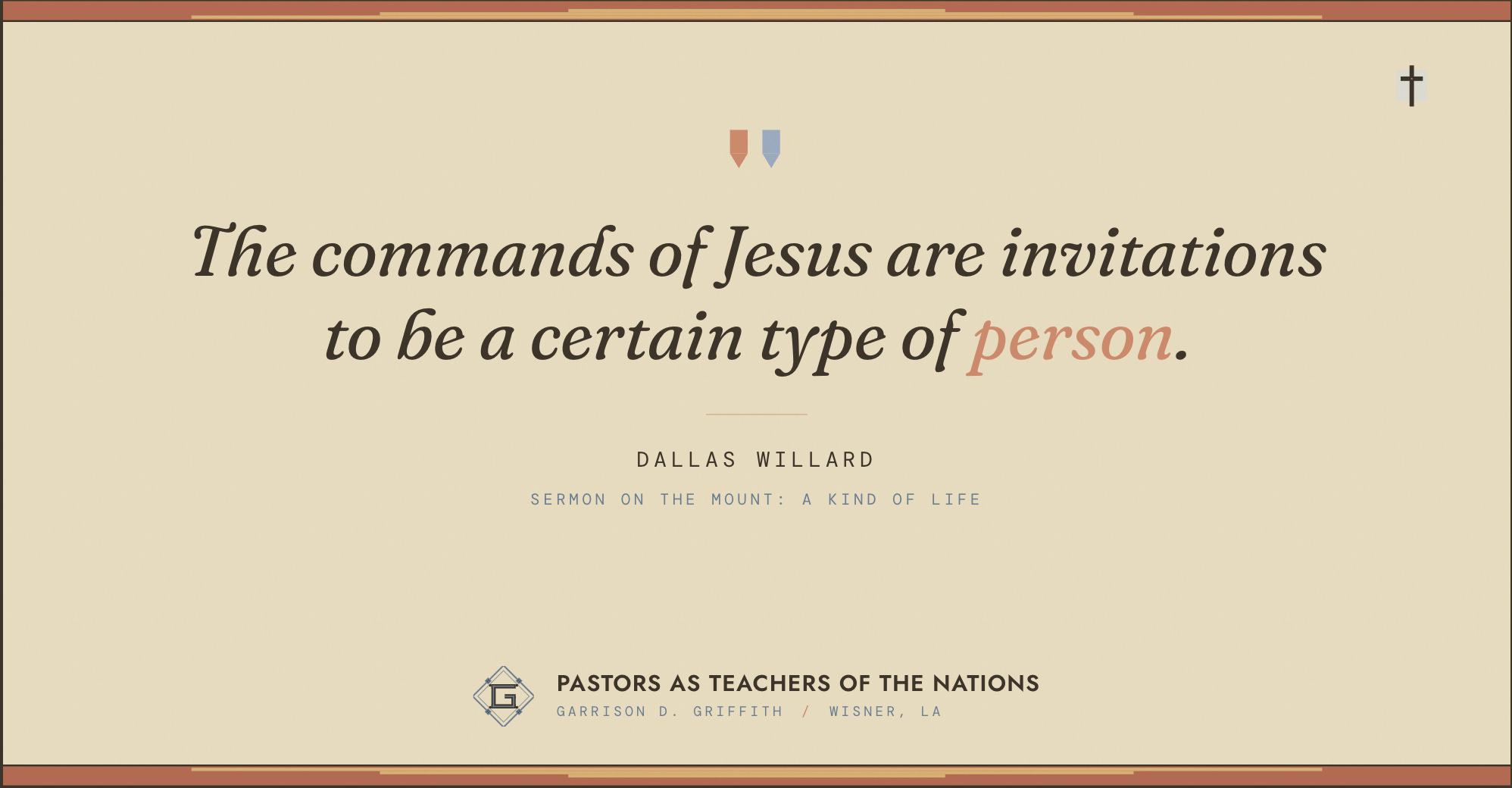
Willard gathers the whole lecture into a single sentence about what the Sermon is for. The commands of Jesus, he says, are “invitations to be a certain type of person.” Through faith and apprenticeship to Jesus, a person has “become inwardly transformed so that his behaviors flow naturally from who they now are as His mature brothers and sisters under the present rule of God.”
The behaviors flow from the person. We get it backwards when we start with the behaviors and hope a person forms around them later. Jesus starts with the person. Form the heart, and the conduct the Sermon describes comes off it the way fruit comes off a healthy tree.
Willard keeps returning to the kingdom as something available now. The Beatitudes, he writes, announce “the free availability of God’s rule and righteousness to all of humanity through reliance upon Jesus himself, the person now loose in the world among us.” The life the Sermon describes is not stored up for heaven. It is on offer today, to anyone willing to apprentice to Jesus and be changed.
A Sermon read as a kind of life is not a softer way of pulling ourselves up by our own effort. The transformation Willard describes comes through reliance on Christ, the person now loose in the world. J. Gresham Machen wrote that the Sermon on the Mount “leads a man straight to the foot of the Cross.” The kind of person Jesus describes is the kind of person only Jesus can produce in us. Scot McKnight calls the Sermon “the moral portrait of Jesus’ own people,” and a portrait is a likeness we grow into.
A note for pastors:
Our task with the Sermon on the Mount is to teach it, not to police it. Those are different jobs, and policing is the easier of the two, which is why we drift toward it.
Policing the Sermon means handing our people the rules and checking their compliance. Teaching it means doing what Willard describes, showing a congregation the kind of person Jesus is forming and then walking with them into the practices that form it. When we preach “turn the other cheek,” the policing instinct reaches for the boundary, measuring how far the rule extends and how often it binds. The teaching instinct asks a better question out loud, in front of our people. What kind of person could take an insult without needing to return it, and how does someone become that?
That question opens onto the real work of formation, the disciplines and the training a church can run. So teach it that way. Open Matthew 5 and tell your people plainly that Jesus is raising the bar, but not where they expect. The righteousness he calls for runs deeper than conduct. He is describing a life they can grow into, not a longer list of rules to keep. Then give them one step toward it. Naming the life is the proclamation. Handing them the means to start living it is the teaching. That is the pastor as teacher of the nations, declaring the kingdom is open and then showing real people how to live in it.
For Reflection
When you open the Sermon on the Mount, are you reading to find the line, the point where you have done enough? Or are you reading to see the person Jesus is forming you into?
Willard warns that legalism is tempted to “abolish your responsibility for judgment.” Where have you reached for a rule because it was easier than becoming the kind of person who would not need one?
Jesus says the life of the kingdom flows from a transformed heart. Are you training your people to keep rules, or teaching them to make kingdom judgments, and giving them somewhere to learn how?
So good! Loved this!
I can’t tell you how much I’ve enjoyed your work. It’s answered the question of: “what would it look like if a pastor actually made discipleship, in the Willardian sense, the axis around which their teaching turned.”It’s been better than I even hoped