


Most of the advice a young pastor receives about his job comes down to two things: keep the church running and keep the people happy. Run the organization well. Meet the needs in front of you. Do not make trouble. That is the contract most congregations believe they signed, and most pastors spend their ministries trying to keep it. Dallas Willard thought that contract was the problem.
In the second-to-last lecture of his 2012 Spirituality and Ministry course at Fuller, the session on the use of spiritual disciplines in pastoral direction, Willard told a room full of pastors that their real work was something else entirely. You can watch or read the lecture here: Spiritual Disciplines in Pastoral Direction. A pastor is a teacher of the nations, and a teacher’s work is direction: telling people, in practical terms, exactly what to do to live with God.
Magnify Your Office
Paul was doing public relations for a ministry nobody respected. “I magnify my office,” he wrote in Romans 11:13, speaking of his apostleship to the Gentiles, which to many of his Jewish friends was like announcing a ministry to dogs. To magnify something is to make it look bigger. When Mary said, “My soul doth magnify the Lord,” she made the Lord look bigger. Willard’s hope for the pastors in that room was that the discussion would help them magnify their own calling: that “the greatness of what you are called to would stand out in your own mind,” and that out of that awareness they could represent it to a world in the dark.
“No one else can do this work. You are the only ones that have the knowledge, the position, and the power to do it.” That is the knowledge theme of the last lecture carried straight into this one. The pastor directs because the pastor knows. Knowledge confers the right to direct action and to teach, and no one else in the community holds that particular knowledge in that particular office.
Direction will stir up trouble, and Willard spent the first part of the lecture getting his students ready for it. He read them prayers from people who had been wounded for the faith: a Serbian bishop martyred for opposing Nazism, Thomas More writing from prison, an unknown prisoner at Ravensbruck. The point was not admiration. It was preparation. “We need to practice these prayers,” he said, because if you make the gospel of the Kingdom and discipleship the center of your work, “you are going to have some people who will be very unhappy with you.” The pastor must be ready to “receive wounds without retaliating, staying all the while faithful to what we have come to understand is right.” And when the wounds come, the instruction is Peter’s: “think it not strange.” Opposition is not a sign that something went wrong. It is the natural course of things, part of the training of a disciple. Teach your people that too, he said, or they will think a good work gone painful means God left the room.
Disciplines Are for Disciples
“Let your words be freighted with grace.” Willard lingered over Paul’s phrase in Ephesians 4 and asked the question underneath it: what is grace? “Grace is God acting.” In silence we learn to listen to God and to speak with Him, and we watch the effect of His presence on the words people hear. That is what a discipline is for. The pastor Willard describes is a “pasture-er,” “someone who arranges for the sheep to find their food and safety and lead them to it.” The disciplines are the pasture. Solitude and silence look like private exercises, but Willard insists they bear their true fruit in community, when people share life together and their times alone enrich the shared life. Memorization, he notes, is simply better done together, and the pastor shepherds that too, along with fasting, study, and worship.
“Disciplines are for disciples and they need to be approached with intelligence and understanding.” Every group has disciplines, whatever it calls them. What most groups lack is any understanding of what they are for, so the growth never comes. The pastor’s work is to relate the disciplines to the gospel itself, and that requires a gospel with a discipleship connection in it. “If you don’t have a Gospel that has any connection with discipleship, then disciplines will be haphazard at best and there will not be an orderly plan for growing in grace and knowledge of Jesus Christ.”
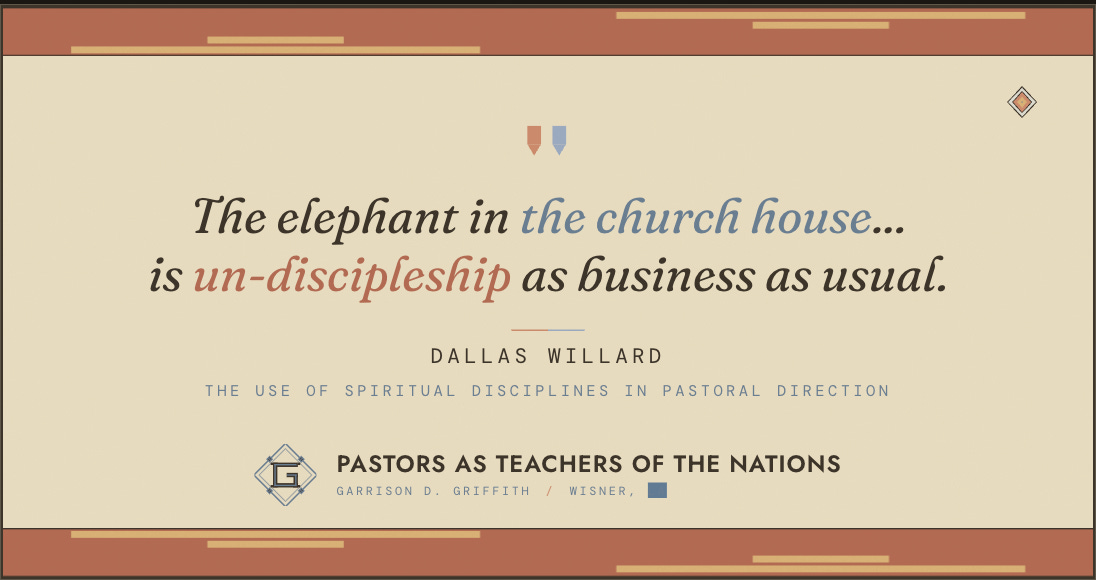
Willard named the obstacle plainly: “The elephant in the church house,” he said, is “un-discipleship as business as usual.” The quiet assumption underneath most congregational life is that we are Christians, not disciples, as if those were two different things. That assumption goes back to the message the church preaches and the invitation it makes. His remedy was what he called discipleship evangelism: evangelize for the purpose of making disciples. Give people the chance to decide to be disciples, and then deal with the consequences, because there will be consequences.
Give Practical Direction
“Don’t just heap guilt on them,” Willard said, “and make them feel they ought to do what Jesus said.” They ought to, but guilt alone never produced a disciple. “You need to give practical direction. We need to tell people in some measure exactly what to do to get them started. They don’t know what to do and they don’t understand the things that happen in the process.” Tell them what to do, and offer them hope that they can do it. At some point, he said, you have to stand up and say, “Everything Jesus said, you can do,” and let the room answer back, “No, we can’t,” and then get the actual objection out on the floor. A man dead convinced he cannot give what he should give will never be argued out of it. He has to be led through it, practice by practice.
Take giving. The basic idea, Willard said, “is quite simple, that you give to participate in the Kingdom. That’s what you are doing when you give and it’s not for God’s benefit.” God owns the cattle on a thousand hills and the Cadillacs too. “Giving is not a plea for help. It is an opportunity” to take part in the most important thing happening on earth. That reframes the annual budget push entirely. The question is not whether the church makes its budget. The question is whether your people know that giving is their invitation into the action of the Kingdom of God, and whether anyone has ever taught them that from 2 Corinthians 9, where Paul shows the poor Macedonians sowing bountifully and reaping bountifully, where God loves a hilarious giver, where grace, God acting in your life to accomplish what you cannot accomplish on your own, comes like water from a spring in the hillside.
None of this fits the contract your people think they signed. Willard’s phrase for the pastor’s slow work is rewriting the congregational contract: “what does the individual person think they have agreed to do and to allow you to do to them as a member of your congregation?” A hundred years ago a pastor was assumed to visit the home, ask after the spiritual life of the family, know the children, pray, and come back in a few weeks to see what had changed. Try that now and you will get told off. “The contract is there,” Willard said. “That’s what you are dealing with, the contract in the minds of your people, and for many of them, it does not include anything like spiritual disciplines.” They grant you the right to expect they show up once in a while. They reserve the right to leave for better services if they stop liking yours.
So how do you rewrite it? Two-pronged, he said. First, in your general teaching and preaching, address the issues head on: what giving is, what the disciplines are, what a disciple is. Then watch how people respond, and work with individuals from there. Carry the new contract in your shirt pocket. Let it out slowly, for people who are ready to hear it. “Go with the people who are ready. Pay attention to them. Endure the others with love and some humor.”
But won’t they leave? Some will. Jesus was prepared for it. Willard pointed to Luke 14, where Jesus rewrites the contract in the minds of the crowd following Him, sharply, on purpose, knowing the cost. If tinkering with the contract in people’s minds draws opposition in an established church, that is not strange either. That is the work.
That is what spiritual leadership actually is. “Spiritual leadership is essentially a matter of being able to induct others into the spiritual life and guide their development in it,” Willard said, “not merely a matter of being mighty in the spiritual one self.” Two models, then. Paul says, “Follow me as I follow Christ.” He takes people by the hand and leads them into the life. Samson is the mighty one. Willard gave him a slogan: “Watch me, baby! I will solve your problems.” The mighty man draws a crowd and makes spectators. The inviting man makes disciples.
Willard’s observation stings: if the two were candidates for a church position today, Samson would win. Strings of churches have been whipped to pieces by the Samson they brought in. The leader the Kingdom needs is the one who takes people by the hand, step by step, practice by practice.
A note for this week: pick one discipline and teach it to your people on Sunday. Take silence. Tell them what it is for, in Willard’s terms: in silence we learn to listen to God and to speak with words loaded with grace. Then give them the exact first step. Ten minutes, phone in another room, one verse of Scripture read slowly, no agenda beyond being with God. Tell them what to watch for during the week: the urge to fill the quiet, the words that come out of their mouths afterward. Ask them next Sunday what they noticed. You have just done the whole lecture in miniature. You related a discipline to the gospel, you gave practical direction, and you started rewriting the contract, one practice at a time.
This week, tell them one thing to do, and do it with them.
For Reflection
Willard asked his students: “what does the individual person think they have agreed to do and to allow you to do to them as a member of your congregation?” What would your people say?
Willard told his students to get the real objection out on the floor: “Now, what are you thinking you can’t do?” What is the one thing your people are convinced they cannot do, and when will you ask them?
Willard asked: “How can we help our people be together in such a way that they really do nourish one another, direct one another and help one another?” What is your part in arranging that?