


A woman in Texas lost her son. She told Dallas Willard that the only place she found relief from the grief was in contemplating the attributes of God. The greatness of God, held before the mind, was what kept her together while facing the deepest pain.
Willard told that story to make a point we are quick to nod at and slow to believe: worship is a discipline, and it makes God larger in the mind than the thing we fear.
This is the twenty-seventh lecture in Willard’s Fuller series, the second on the disciplines of engagement, and it moves through three of them: worship, celebration, and prayer. You can watch the full lecture or read the transcript here: https://conversatio.org/worship-celebration-prayer-2/
Worship makes God large. Celebration makes that largeness personal. Prayer turns it into a conversation. Together they are the steps a person takes into the kingdom of God.
Worship Cuts the Universe Down to Size
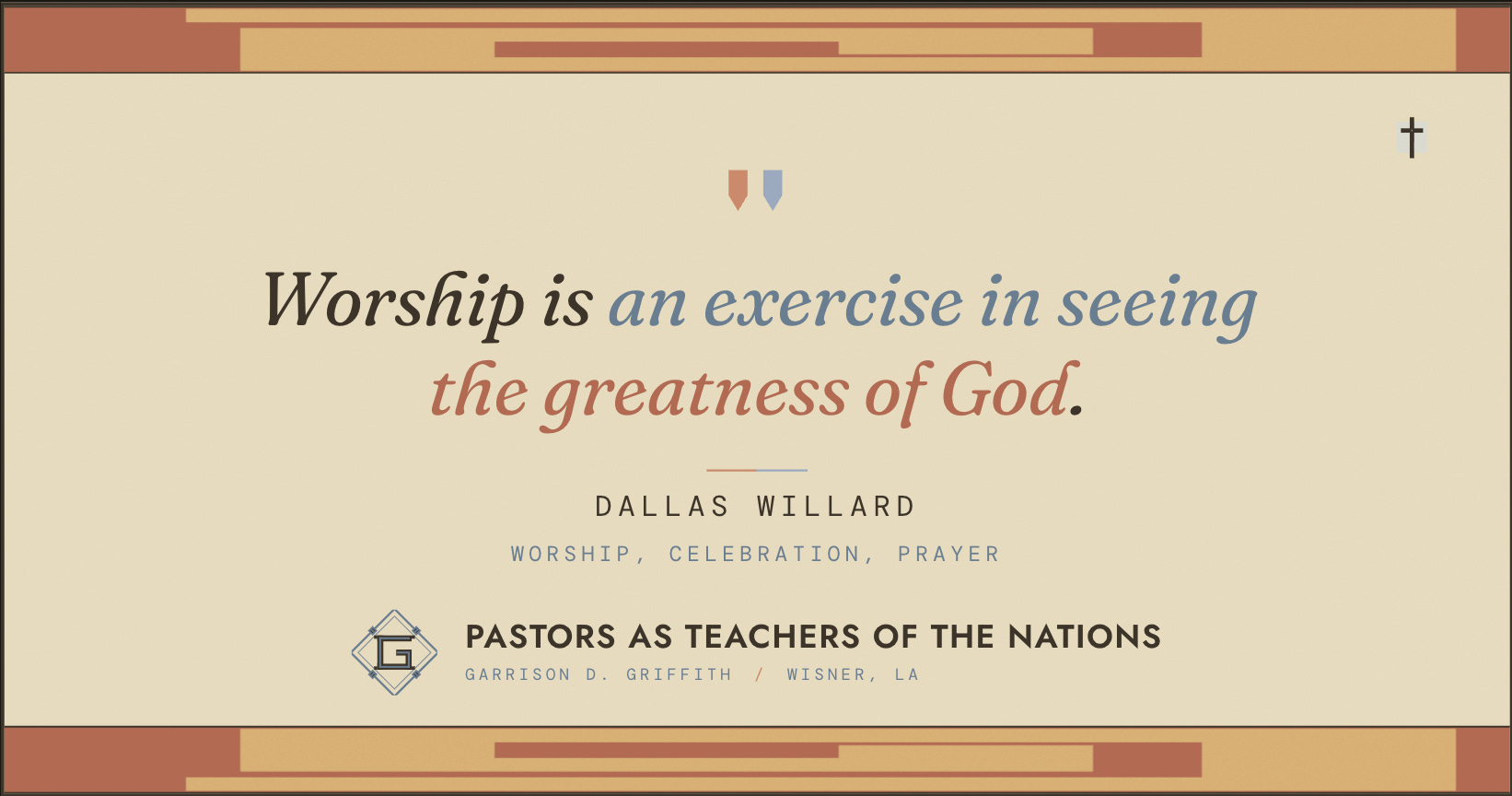
“Worship is an exercise in seeing the greatness of God,” Willard tells his students. “That’s the primary, it’s a choice.” We imagine a great big universe with a little bitty God somewhere inside it. Willard turns it around: “a itty bitty universe and a great big God.” Beside a God that size, he says, the universe is “little more than a flick of a finger.”
Worship places everything in its proper view: a large God, a small universe, and troubles smaller than both. It is a choice we make with the mind, to set God before us until we see Him closer to His real size. David kept the practice. “I have set the Lord always before me. He is at my right hand so I shall not be moved,” Willard quotes, and names the mechanism: “that’s an effect of worship.” The steadiness David describes grows in a person who has cultivated the habit of keeping God in view.
When our view of God and self is right, the rest of life looks different. Willard puts it in the grieving mother’s own words: “since there is God, everything else looks different to me.” Anger looks different. Fear looks different. He does the same with Daniel. We say “Daniel in the lions’ den,” but Willard turns to the lions and asks, “Whose den was that, by the way?” God was in that den with Daniel, so it was really, in Willard’s phrase, “the lions in Daniel’s den.” The lions were real. God was larger.
This is why worship carries weight. In The Great Omission, Willard writes that “vision of God secures humility. Seeing God for who He is enables us to see ourselves for who we are.” A clear sight of God gives us nerve. We “practice calm and joyful noncompliance with evil of any kind,” because we have seen who stands in the den beside us.
Celebration Is the Completion of Worship
Worship sets the mind on who God is. Celebration takes the next step and remembers what He has done. “Celebration is tied to ‘me’ in a way that worship is not,” Willard says. “In celebration, I rejoice over what He has done for me and for mine. This is largely a discipline of remembering.” He reaches for an old word. After God defeated the Philistines, Samuel set up a stone and named it Ebenezer, 1 Samuel 7:12, “Till now the LORD has helped us.” To celebrate is to raise that stone in our own lives, to name the specific mercies and count them out loud.
“Do you think God has done well by you?” He puts it to the class the way he would put it to a congregation, because he knows what he will find. Many have gone their whole lives without the question. Some, asked for the first time, will say no. That is why the question matters. “It is hard to worship God if you think He has not done well by you,” Willard says, and so “celebration is kind of the completion of worship.” The mind that has seen God’s greatness has to bring it home, or the greatness stays abstract.
Celebration is a thing we choose. Richard Foster guards the same point: celebration “is not something that falls on our heads,” it is “an act of the will.” Willard puts a body on it. Practice saying it out loud, he tells the class, “God has done well by me,” even if we have to “slip out into the brush here” to do it. The words come before the feeling and train it.
And the discipline does something to grief. “When you celebrate, you turn loose of your sorrows,” Willard says, “and you take hold of good things and you praise God for them.” He refuses to let holiness be measured by how much it costs us. “If it’s holy, it hurts,” the objection runs, and Willard answers, “No, that’s not true.” Celebration is holy, and it makes, in his words, “our deprivations and sorrows seem small.”
Talking About What We Are Doing Together
Worship makes God large and celebration makes Him personal, and in prayer both turn into a conversation. Willard’s definition is plain. “Prayer is talking to God about what we are now doing together.” The phrase carries a whole theology. God and I are at work on something, side by side, and I can talk to Him about it as we go.
Prayer, he says, “isn’t like putting money in the Coke machine,” where the right coins in the right slot produce the outcome. A machine has no interest in working with us. God does. Prayer “is a conversation. It is an interaction between people.” Jesus taught it as one. When the disciples asked Him to teach them, “He gave them words,” Willard says, and the words begin with address. “Our Father.” We say who He is before we say what we need.
The structure of the prayer offers us a lesson in prayer. The first request is “Hallowed be Thy Name,” that God’s name be held holy in us. The second is “Thy Kingdom come,” which Willard describes as “the action of God coming into the world where it is not present.” Only after God’s name and God’s kingdom do we reach our own bread. Scot McKnight, reading the same prayer, lands where Willard does: the Lord’s Prayer “is not intercession. It is enlistment.” We pray it and find ourselves signed up for what God is doing.
That enlistment has a blunt name: prayer is “a power-sharing arrangement for a world of recovering sinners.” God shares the running of His kingdom with people He is still repairing, and He sets the entrance low. “Prayer and giving are the first two moves,” Willard says. “Anyone can start there. You don’t have to be very sophisticated or advanced.” A person who prayed for the first time this morning has already begun to engage the kingdom of God.
A Note for Pastors
Worship, celebration, and prayer are one motion, and a pastor can lead it. I learned the shape of it at a prayer retreat, and we have prayed it together as a church ever since. It works for a congregation gathered and for one person alone, and it moves in three directions.
We begin by looking upward. We fix our minds on God and praise Him for who He is, then celebrate what He has done. I ask our people to speak up, each one naming a reason to thank God for God. A room learns to worship by hearing worship.
Then we turn inward. We pray with David, Psalm 139:23-24, “Search me, O God, and know my heart... see if there be any grievous way in me, and lead me in the way everlasting.” Having looked hard at God, we let God look hard at us, and we ask Him to lead us out of whatever He finds.
Last we look outward. We bring the needs of the congregation and the community to God together, and we pray for His kingdom to come in our lives and our neighborhoods. We look upward until God fills the view, inward until He has searched us, and outward until His kingdom is what we most want.
For Reflection
Dallas Willard asked his students, “Do you think God has done well by you?” Sit with it before you answer for anyone else. Can you name three specific mercies from the past year and say out loud that God has done well by you?
When you walked into this week, what was the largest thing in it? If the diagnosis or the deadline or the empty pew loomed larger than God, what would it take to set God before your mind until He is the largest thing you see?
Is your praying a conversation about what you and God are doing together, or is it closer to coins in a machine? Where would your prayers change if you hallowed His name and wanted His kingdom before you reached your own need?
I keep asking why I’ve never heard of Dallas Willard. Very good article!